
Published 2026-10-27 · 7 min
Average payment term in the Netherlands: when do companies actually pay?
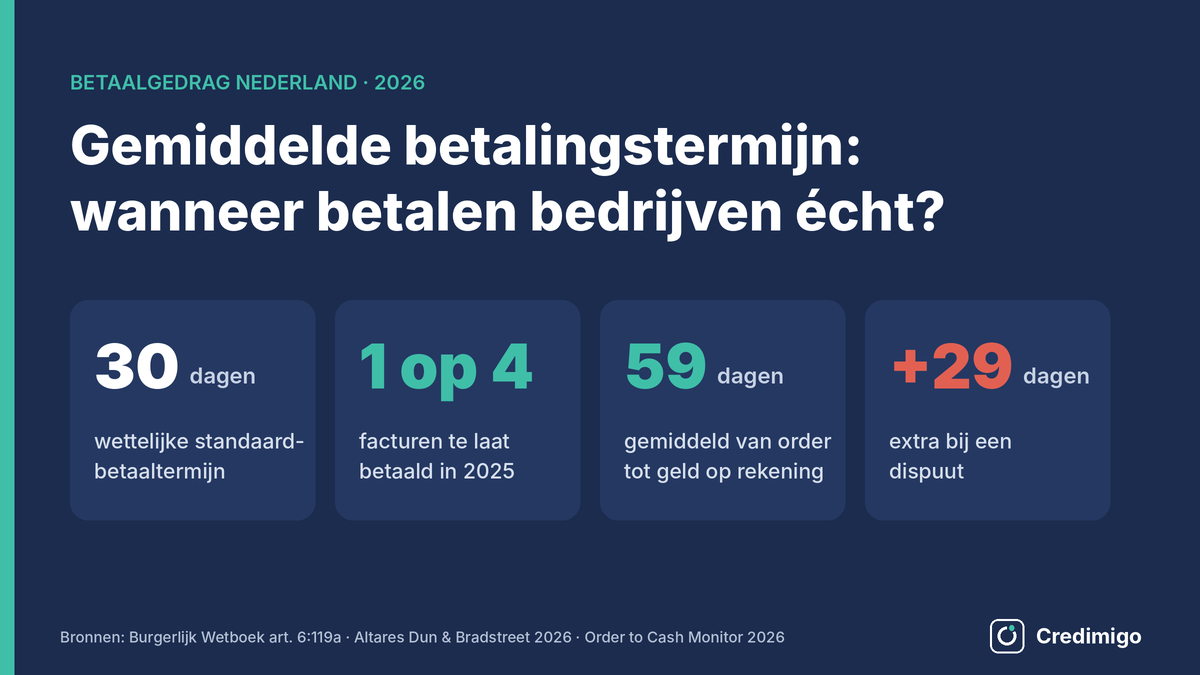
The statutory payment term in the Netherlands is 30 days when nothing else is agreed. Between businesses a maximum of 60 days may be agreed, and a large company may make an SME supplier wait no more than 30 days. In practice 1 in 4 invoices is paid late (25.3% in 2025) and it takes 59 days on average from order to cash.
Day 31, and nothing has arrived
Your invoice says "payment within 30 days". The customer agrees and you deliver. On day 31 nothing has come in, and on day 45 still nothing.
You are not alone. The Netherlands has one of the strictest payment standards in Europe, but that standard says little about when money actually lands in your account. Below are the latest 2026 figures: the legal term, how long companies really wait, and what you can do to get paid faster.
The short answer
- The statutory term is 30 days if nothing is agreed. B2B may agree up to 60 days; large companies may make SME suppliers wait at most 30 days.
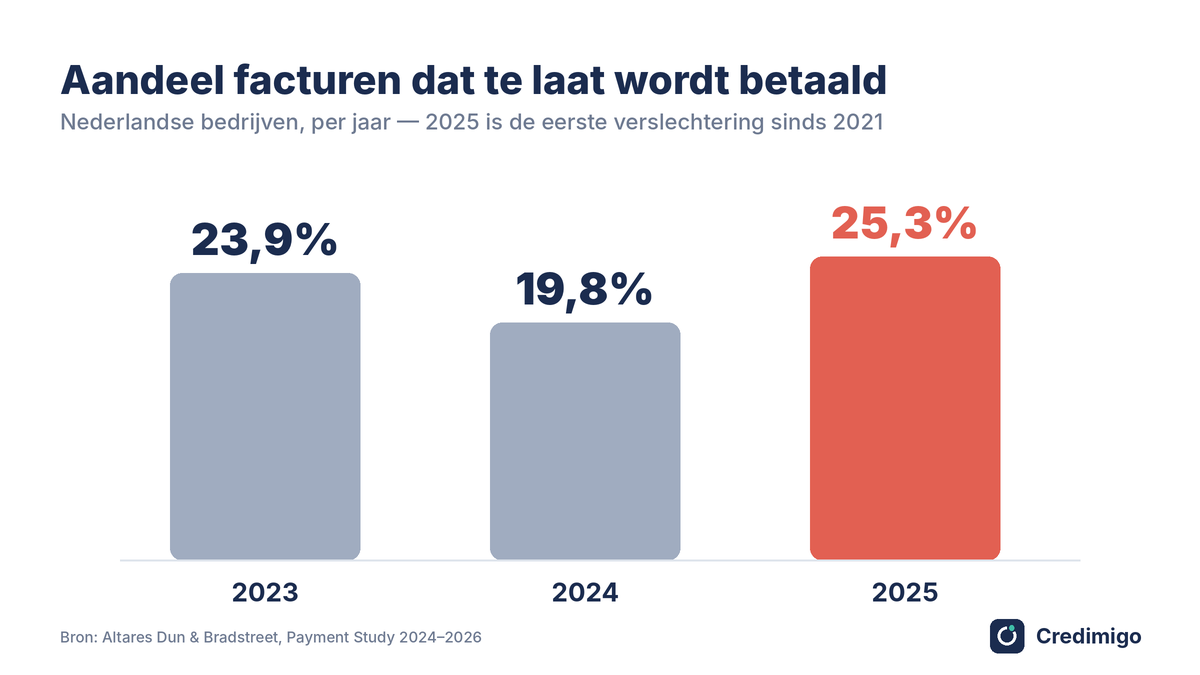
- In practice 1 in 4 invoices is paid late: the share rose to 25.3% in 2025.
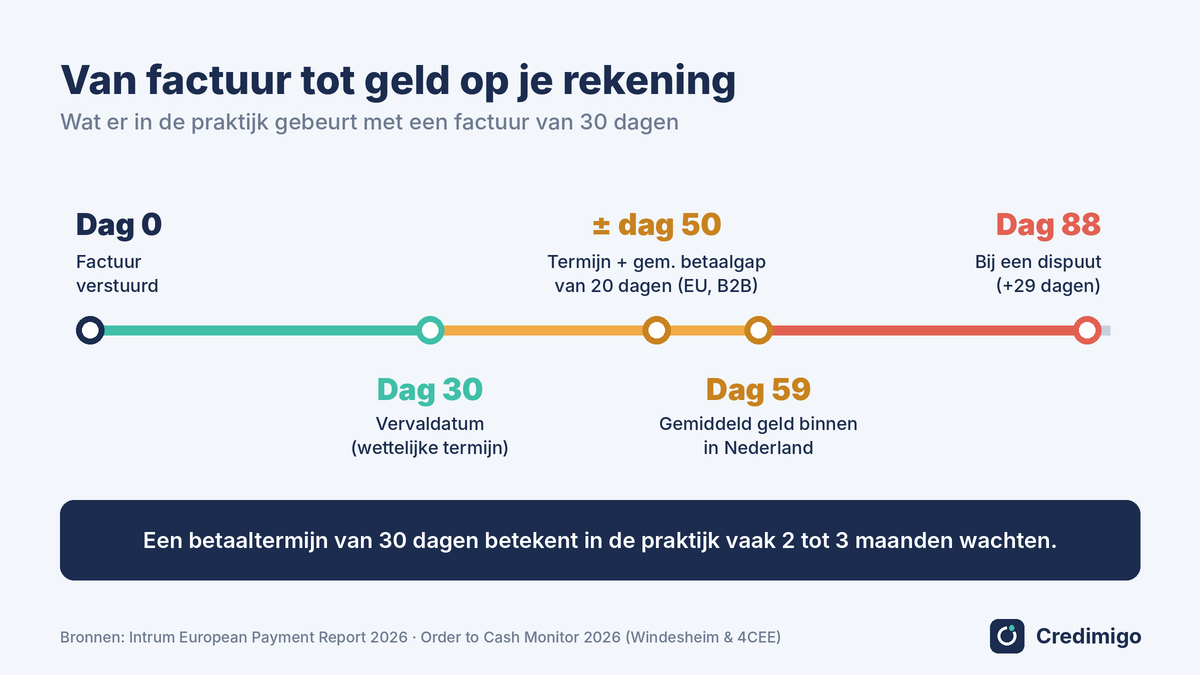
- From order to cash takes 59 days on average; a dispute adds another 29 days.
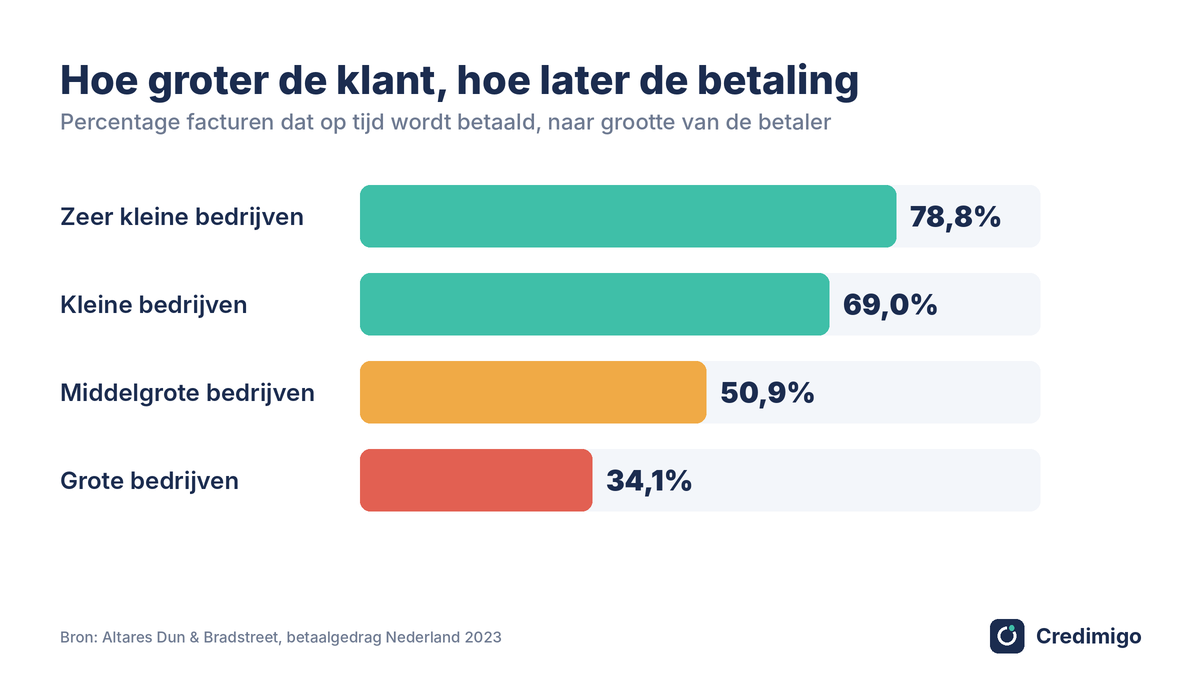
- Large companies pay worst: very small firms paid 82.2% of invoices on time, large firms only 38.6%.
What is the statutory payment term in the Netherlands?
The rules are in article 6:119a of the Dutch Civil Code:
| Situation | Maximum payment term |
|---|---|
| Nothing agreed | 30 days after receipt of invoice |
| Business ↔ business (B2B) | Max. 60 days, unless not unreasonable for the supplier |
| Large company → SME supplier | Max. 30 days (since 1 July 2022) |
| Government → business | 30 days |
If your customer pays late, you are automatically entitled to statutory commercial interest: 10.4% since 1 July 2026 (source: Dutch government). You are also entitled to at least €40 in collection costs.
How many invoices are paid late?
After years of improvement, payment behaviour turned in 2025. According to Altares Dun & Bradstreet, 74.7% was paid within the agreed term in Q4, versus 80.2% a year earlier. Hospitality fell hardest: 76% on time versus 85.7%.
Real non-payment remains rare: only 0.3% of invoices exceed the term by more than 90 days.
How long do you wait for your money?
The Order to Cash Monitor 2026 (Windesheim University and 4CEE) measures the full journey from order to cash: 59 days on average. Dispute resolution time nearly doubled in one year, from 14.7 to 28.9 days.
Europe is no better. Intrum's European Payment Report 2026 shows the B2B gap between actual payment time and agreed term grew from 16 days in 2023 to 20 days, while the average EU B2B term rose from 60 to 63 days.
Why does the Netherlands still look like a good payer?
Only in European perspective. According to Atradius, almost three quarters of Dutch B2B sales are on credit, and just under a fifth of Dutch B2B invoices are overdue versus almost a quarter in Western Europe. The problem is a structural delay of a few weeks on very many invoices; almost a third of Dutch suppliers report cash-flow pressure caused by customers' liquidity problems.
The bigger the customer, the later the payment
In the 2023 measurement, very small firms paid 78.8% of invoices on time and small firms 69%, versus 50.9% for medium and 34.1% for large companies. The 30-day rule has had limited effect so far; the government sees average terms from large firms to SMEs down by three days since July 2022.
Why do companies pay late?
Usually it is the process, not unwillingness:
- Slow approval: the main reason at one in three medium and large companies.
- Invoice errors: wrong price, missing PO number or deviating delivery date lead to disputes.
- PDF instead of e-invoice: only 11% send e-invoices, 76% still use PDF, so the term starts later.
- Deliberately paying later: about 15% of companies do it to improve their own cash flow.
The result is a chain reaction: 62% of companies say they pay their own suppliers late because they are paid late themselves.
What does late payment really cost?
Illustration: you invoice €100,000 a month and customers pay 29 days late on average (59 instead of 30). Around €95,000 extra is permanently tied up in receivables. Financed at 8%, that costs over €7,500 a year in interest. According to Intrum, 57% of companies missed growth targets because of late payments.
7 ways to get paid faster
- 1. Invoice immediately after delivery.
- 2. Put a hard due date on the invoice and mention statutory commercial interest for late payment.
- 3. Add a payment link.
- 4. Know your customer's purchasing process: PO number, reference and invoice address.
- 5. Send a reminder before the due date.
- 6. Automate follow-up at day +1, +7 and +14.
- 7. Steer on data: track your DSO and each customer's payment pattern.
Want to lower DSO structurally? Read Reduce DSO: 15 ways to get invoices paid faster.
What is changing in Europe?
The European Commission proposed a Late Payment Regulation in late 2023 with a hard 30-day maximum for all business transactions. Parliament has set its position; member states still have to conclude negotiations. Until then the Dutch Civil Code applies.
How Credimigo helps
Credimigo is AI-driven accounts receivable software. It sends reminders at the right moment, spots customers who structurally pay late and shows in one dashboard where your cash is stuck. You stay in control of your receivables and customer relationships. Credimigo is software, not a collection agency.
Frequently asked questions
What is the average payment term in the Netherlands?
The statutory default is 30 days. In practice it takes 59 days on average from order to payment, and over a quarter of invoices are paid late (Altares, 2025).
Is a 14-day payment term allowed?
Yes. A shorter term is always allowed if agreed in advance, for example in your quote or terms and conditions.
May a large company make me wait 60 days?
Not if you are an SME. Since 1 July 2022 a large company may agree at most 30 days with an SME supplier; a longer term automatically becomes 30 days.
What can I charge when a business customer pays late?
Statutory commercial interest (10.4% since 1 July 2026) and at least €40 in collection costs, without first sending a reminder.
What is DSO?
Days Sales Outstanding: the average number of days between sending an invoice and receiving payment.
Bronnen
- Altares Dun & Bradstreet – Payment Study
- Accountant.nl – Betaalgedrag Nederlandse bedrijven verslechterd
- MKB Servicedesk – Order to Cash Monitor 2026 (4CEE & Windesheim)
- Intrum – European Payment Report 2026
- Atradius – B2B payment practices in the Netherlands
- Rijksoverheid – Hoogte wettelijke rente
- Burgerlijk Wetboek Boek 6, art. 6:119a
- Ondernemersplein – Betalingstermijnen, incassokosten en wettelijke rente
Analyseer je eerste factuur gratis
Upload een openstaande factuur en zie binnen een minuut je Recovery Score, de juiste taal voor je debiteur en een kant-en-klare laatste aanmaning.
Analyse an invoice free