
Published 2026-10-19 · 9 min
How to get customers to pay your invoices faster: the complete accounts receivable follow-up schedule (2026)
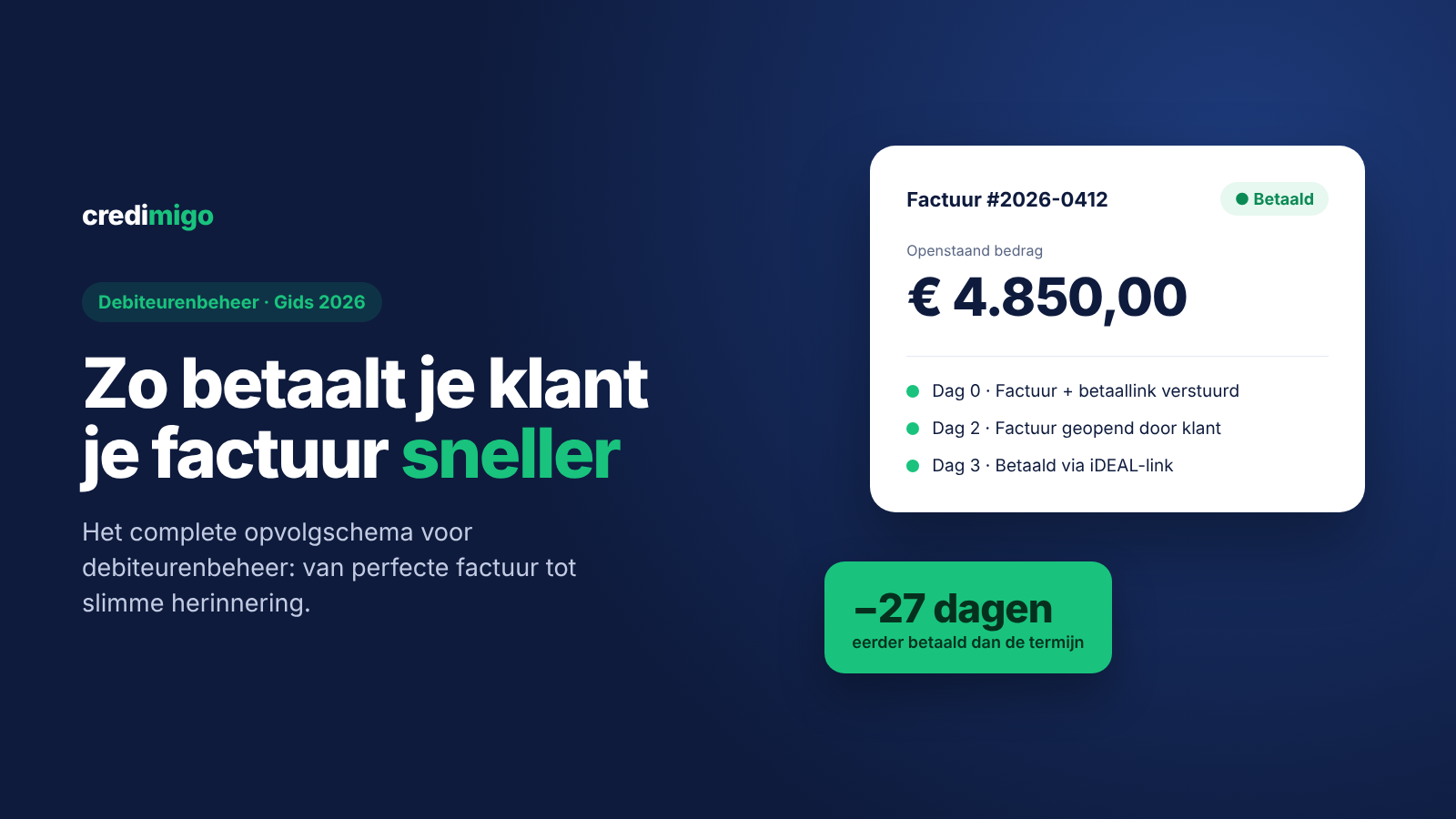
You get the best results from accounts receivable follow-up by getting three things right. First, a complete invoice with a direct payment link. Second, a fixed follow-up schedule that starts before the due date. Third, automation, so no reminder is ever forgotten. Businesses that do this consistently get paid measurably faster and spend far less time chasing payments.
What is accounts receivable management?
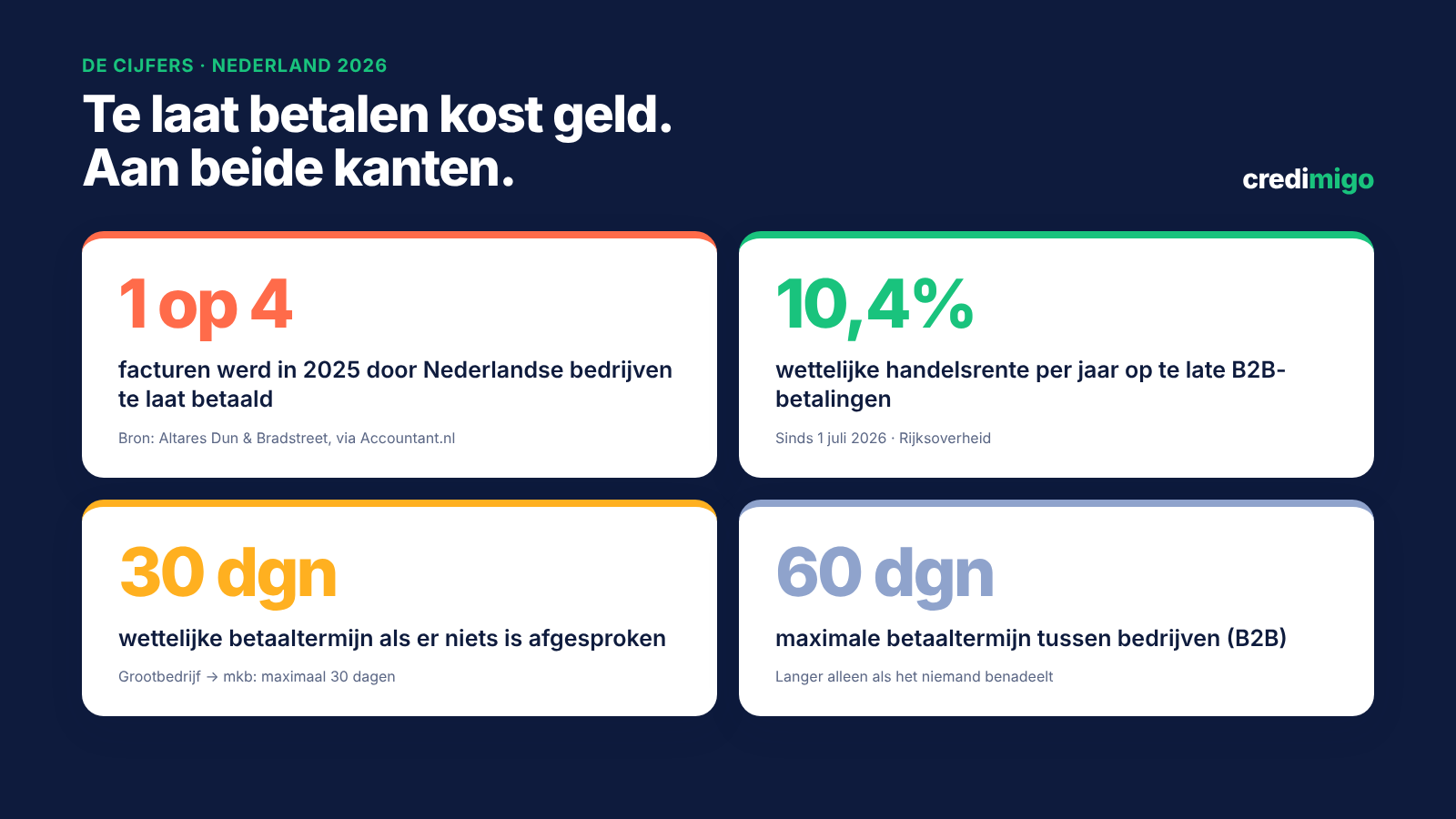
You delivered the work, sent the invoice, and then… silence. You're not alone: Dutch businesses paid over a quarter of their invoices late last year according to Altares Dun & Bradstreet — the first deterioration in payment behaviour since 2001. The good news: whether you're paid on day 5 or day 50 is largely in your own hands.
Accounts receivable management is the process of making sure customers pay on time — from accepting a customer, through invoicing, to the last reminder or collection. It's about prevention (making payment easy) and follow-up (reminding at the right moment, in the right tone).
Why late invoices cost so much
An unpaid invoice is effectively an interest-free loan to your customer. It costs working capital, growth and time. The key rules in the Netherlands:
- No payment term agreed? Between businesses 30 days applies automatically.
- Maximum term between businesses: 60 days, longer only if not unfair to either party.
- Large company paying an SME or freelancer: within 30 days.
- Public bodies: within 30 days of receiving the invoice.
If a business customer pays late you're entitled to statutory commercial interest: 10.40% since 1 July 2026. For consumers the statutory rate is 4% since 1 January 2026. EU-wide, Directive 2011/7/EU sets a similar 30/60-day framework.
Step 1: Start before the invoice, with clear agreements
Getting paid faster starts with the quote. Agree upfront:
- A short payment term — 14 days is defensible in many sectors.
- Who approves and pays the invoice; at larger customers that's often not your contact.
- Whether a PO number is required — without one, invoices are often rejected silently.
- Your terms and conditions, including interest and collection costs for late payment.
For new or large jobs, check creditworthiness upfront or ask for a deposit.
Step 2: Send an invoice that can be paid immediately
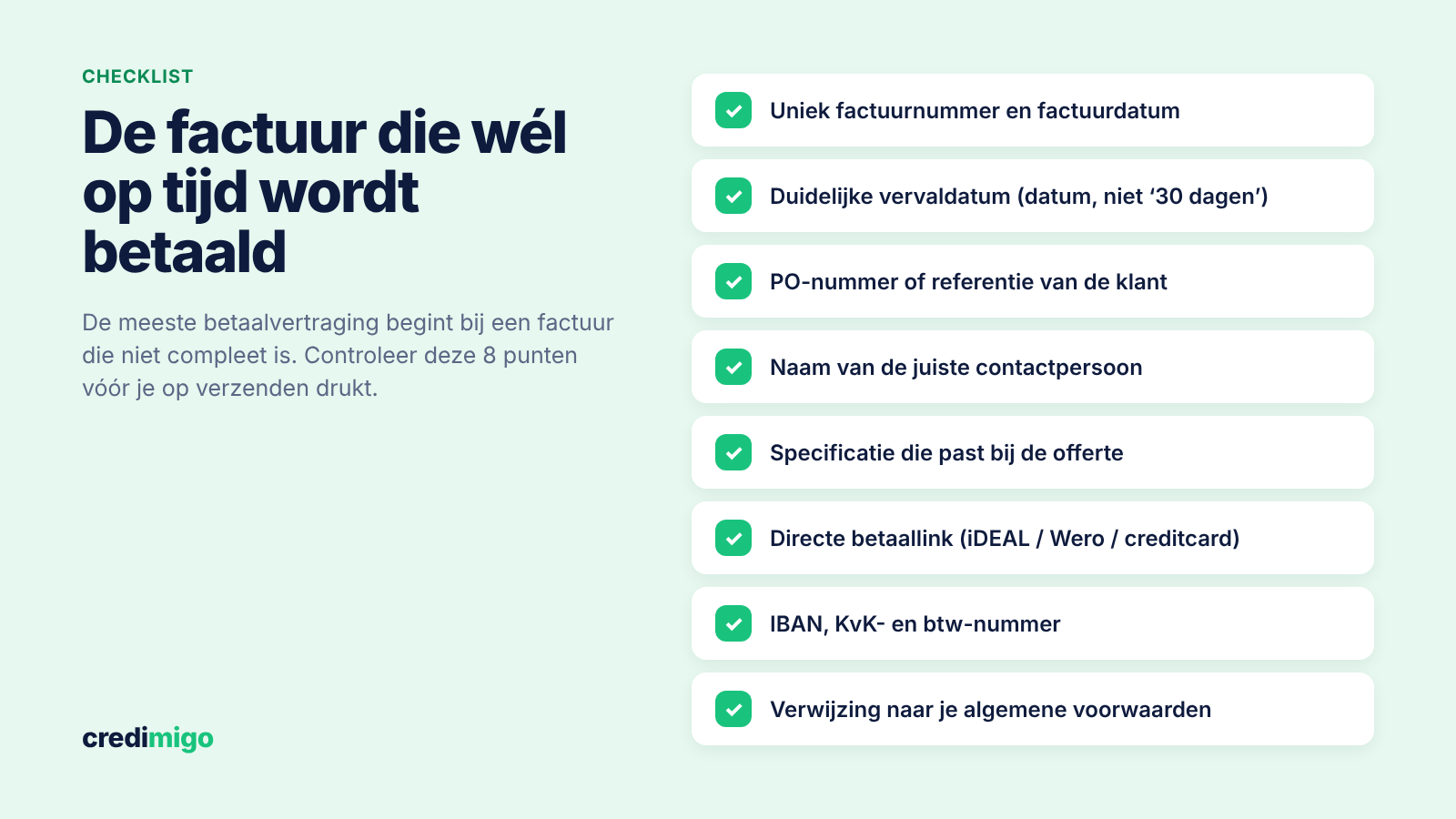
Most delays aren't unwillingness: the invoice is incomplete, reaches the wrong person or takes too much effort. Check before sending:
- Unique invoice number and date
- A concrete due date ("by 2 November 2026" instead of "within 30 days")
- Customer PO number or reference
- The right contact person's name
- Line items matching the quote
- A direct payment link (iDEAL, Wero or card)
- IBAN, company and VAT number
- A reference to your terms and conditions
Tip: the payment link is the biggest speed gain. On a phone, paying becomes a single tap.
Step 3: Use a fixed follow-up schedule
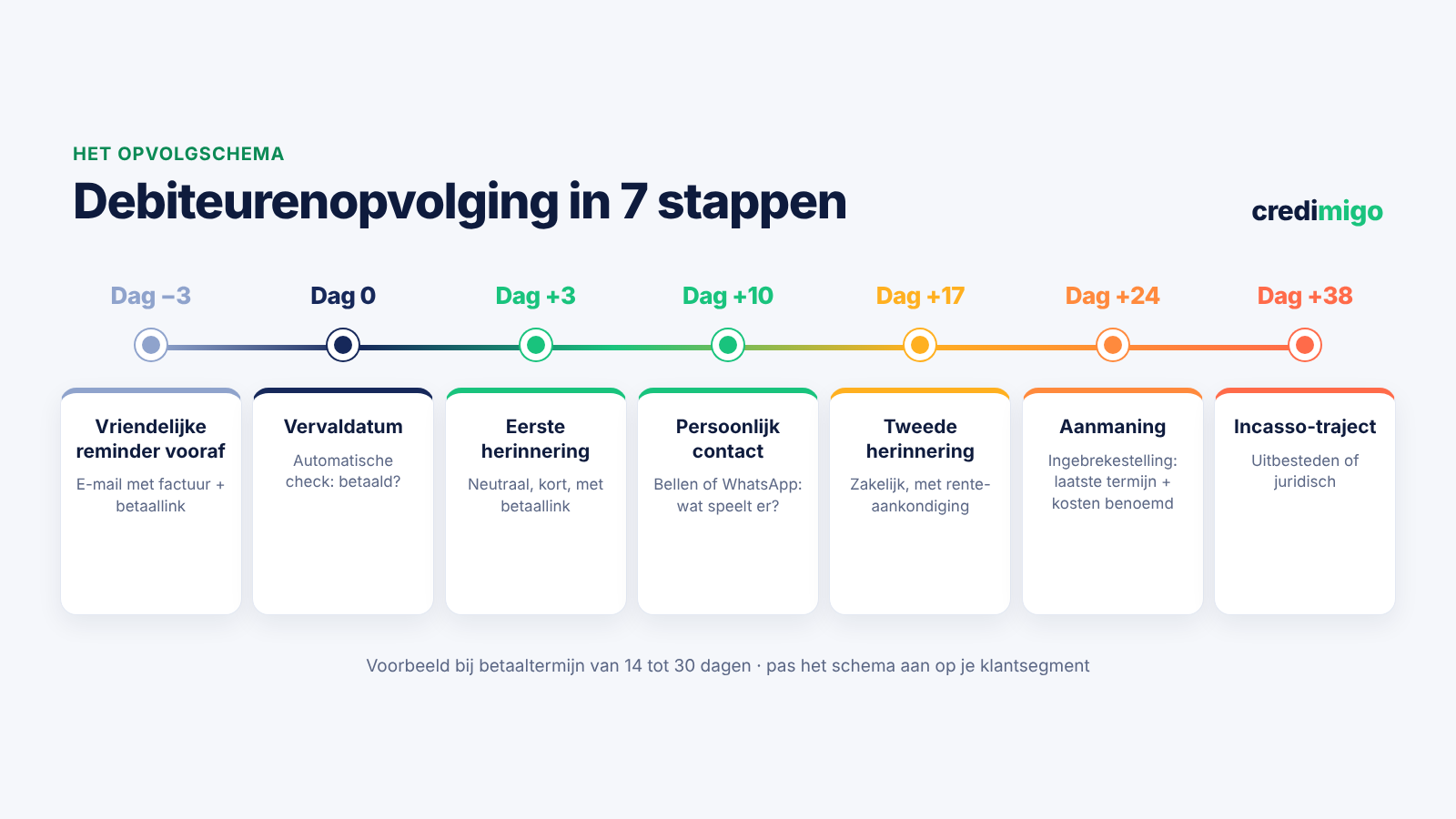
The biggest difference between fast and slow payers is consistency. Reminders sent "when you remember" don't work; a fixed rhythm does.
| When | Action | Tone |
|---|---|---|
| Day −3 | Friendly reminder before the due date, with payment link | Service-minded |
| Day 0 | Due date: automatic check whether paid | – |
| Day +3 | First reminder | Neutral and short |
| Day +10 | Personal contact: call or WhatsApp | Solution-focused |
| Day +17 | Second reminder, announcing interest and costs | Businesslike |
| Day +24 | Formal demand / notice of default with final deadline | Formal |
| Day +38 | Start collection | Legal |
Day −3 matters most: a reminder before the due date feels like service, not chasing, and gets the invoice into the next payment run.
Step 4: Email templates that work
Before due date (day −3) — Subject: Invoice [number] is due on [date]. "Hi [name], a quick reminder: invoice [number] for €[amount] is due on [date]. You can pay directly here: [payment link]. Anything unclear? Let us know and we'll sort it right away."
First reminder (day +3) — Subject: Reminder invoice [number]. "Hi [name], we haven't yet received payment for invoice [number] (€[amount], due [date]). Perhaps it slipped through in a busy week. You can pay directly here: [payment link]. Already paid? Please ignore this email."
Second reminder (day +17) — Subject: Second reminder – invoice [number] is [x] days overdue. "Dear [name], invoice [number] for €[amount] is now [x] days overdue despite our earlier reminder. Please pay within 7 days via [payment link]. After this period we will charge statutory commercial interest and collection costs in line with our terms."
Why it works: every message contains the amount, the due date and a payment link.
Step 5: Call at the right moment
A call around day +10 tells you why the invoice is unpaid. Each answer needs a different approach:
- Invoice lost or misaddressed: resend to the right person, with payment link.
- Dispute about the content: resolve it and send a credit note or correction.
- Cash problems: agree a concrete payment plan (amounts + dates) and confirm it by email.
A payment plan is almost always better than a customer who stops paying altogether.
Step 6: Know what you may (and must) do legally
- Interest: for business customers in the Netherlands statutory commercial interest runs automatically from the day after the due date, if a fixed term was agreed.
- Collection costs: for Dutch consumers you must first send a 14-day letter; amounts follow a statutory scale. With business customers your terms can differ; if silent, the same scale applies.
- Tone: stay professional. An aggressive demand usually damages the relationship more than it yields.
Step 7: Measure results with the right KPIs
- DSO (Days Sales Outstanding): (outstanding receivables ÷ revenue for the period) × days in the period.
- Percentage of invoices paid on time.
- Ageing analysis: amounts outstanding 0–30, 31–60, 61–90 and 90+ days. The older a claim, the lower the chance of payment.
Review monthly. A customer drifting into older buckets? Time for a conversation, or prepayment.
Step 8: Automate the follow-up
A schedule only works if it runs every time — busy weeks and holidays are where manual follow-up breaks down.
With Credimigo you automate accounts receivable with AI: reminders go out at the right moment, in the right tone, with a direct payment link, and one overview shows what's open and where action is needed. You stay in control and keep the customer relationship — Credimigo is software, not a collection agency.
Conclusion: getting paid fast isn't luck, it's a process.
Frequently asked questions
How do I get customers to pay my invoices faster?
Use a short payment term, add a direct payment link to every invoice, send a reminder before the due date and follow up late payments on a fixed schedule. Automation ensures no step is skipped.
When should I send the first payment reminder?
A few days before the due date, as a friendly service. The first real reminder after the due date goes out within 3 to 5 days.
How many reminders before collection?
Typically one or two reminders, a personal contact moment and a formal demand. If payment still doesn't come, collection is the logical next step.
Can I charge interest on late payment?
Yes. In the Netherlands statutory commercial interest is 10.4% per year since 1 July 2026; for consumers 4% since 1 January 2026.
What is a good payment term?
Many SMEs use 14 or 30 days. Without agreement, 30 days applies between businesses; the maximum is in principle 60 days.
What is DSO and what's a good value?
Days Sales Outstanding is the average number of days between invoice and payment. The closer it is to your own payment term, the better.
What if a customer disputes the invoice?
Call straight away, find out what's wrong and fix it with a correction or credit note.
Bronnen
Analyseer je eerste factuur gratis
Upload een openstaande factuur en zie binnen een minuut je Recovery Score, de juiste taal voor je debiteur en een kant-en-klare laatste aanmaning.
Analyse an invoice free