
Published 2026-10-13 · 9 min
Reduce DSO: 15 ways to get invoices paid faster
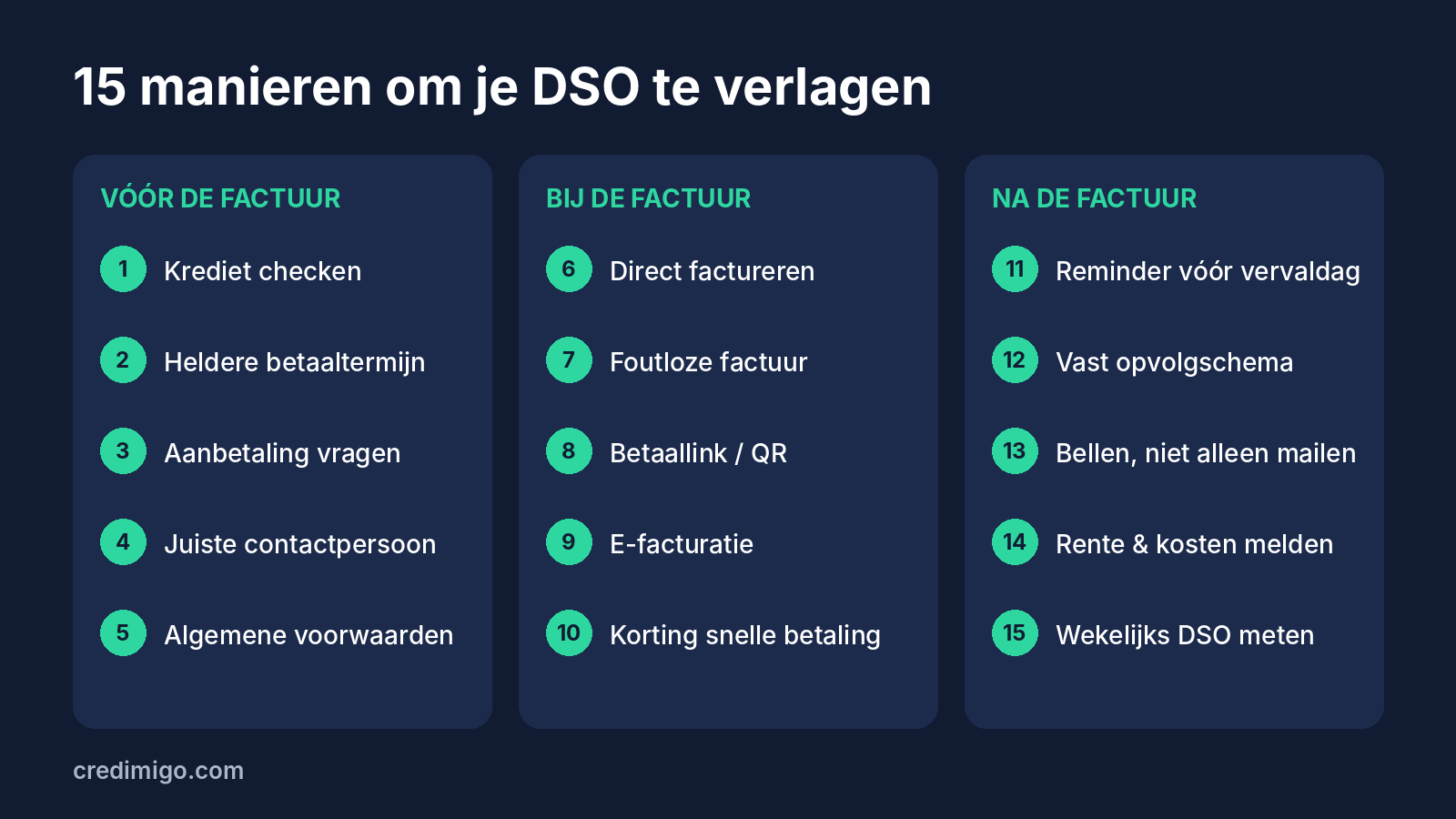
You reduce your DSO (Days Sales Outstanding) by acting at three moments. Before the invoice, agree clear terms. At the invoice, send it immediately, error-free and with a payment link. After the invoice, follow up consistently on a fixed schedule. Businesses that automate all three phases often cut their DSO by 10 to 20 days – freeing working capital without a single euro of extra revenue.
What is DSO?
DSO stands for Days Sales Outstanding: the average number of days between sending an invoice and receiving the money. It is the key metric of accounts receivable. A high DSO means your customers effectively get an interest-free loan from you.
Research by Altares Dun & Bradstreet shows Dutch businesses paid more than a quarter of their invoices late last year – the first deterioration since 2001. The good news: how fast you get paid is largely in your own hands.
How to calculate DSO
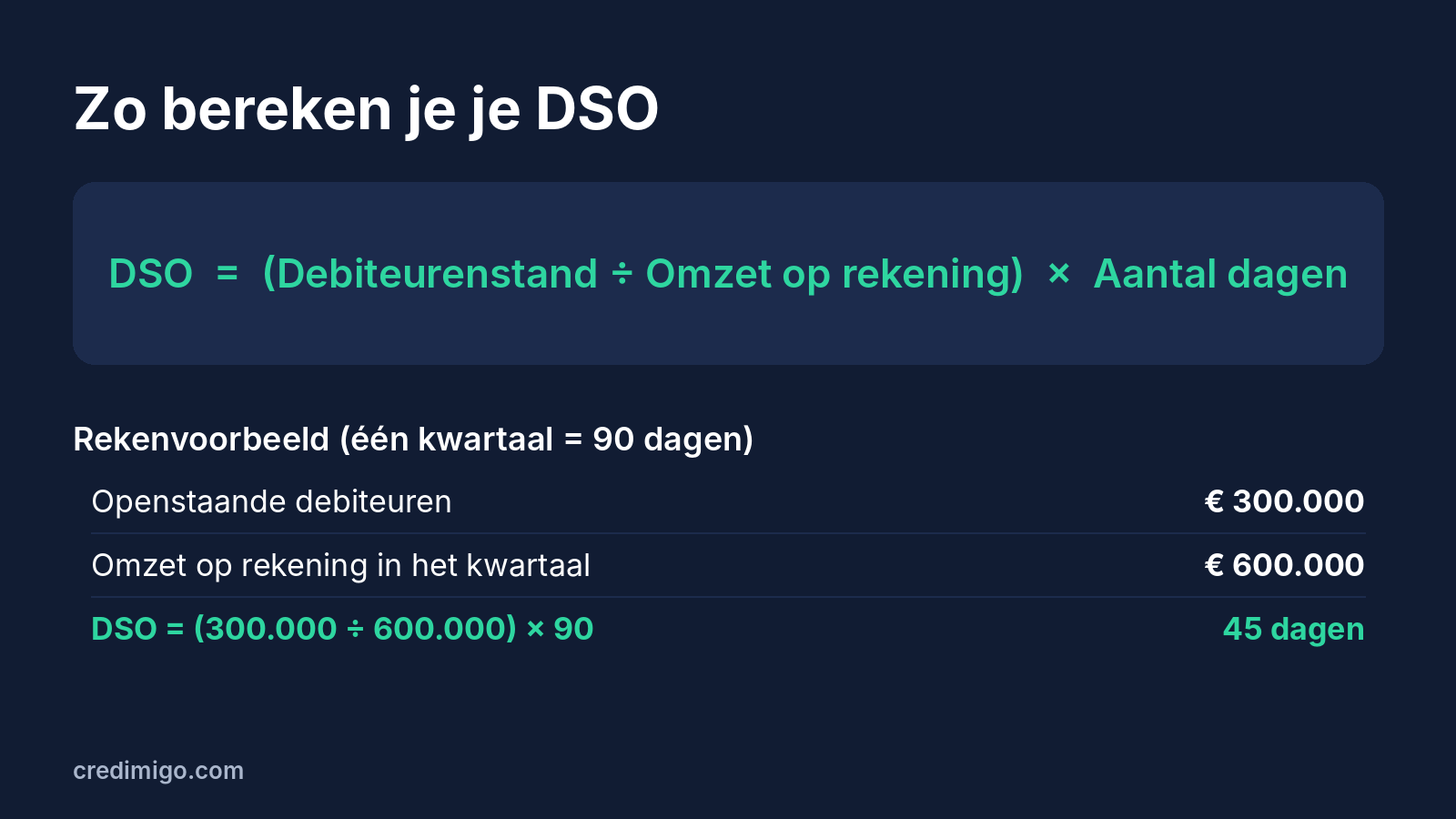
DSO = (accounts receivable ÷ credit sales) × number of days in the period
Example: €300,000 outstanding and €600,000 invoiced this quarter gives (300,000 ÷ 600,000) × 90 = 45 days. With 30-day terms, customers pay 15 days late on average – that's the gap to close.
Why every day of DSO costs money
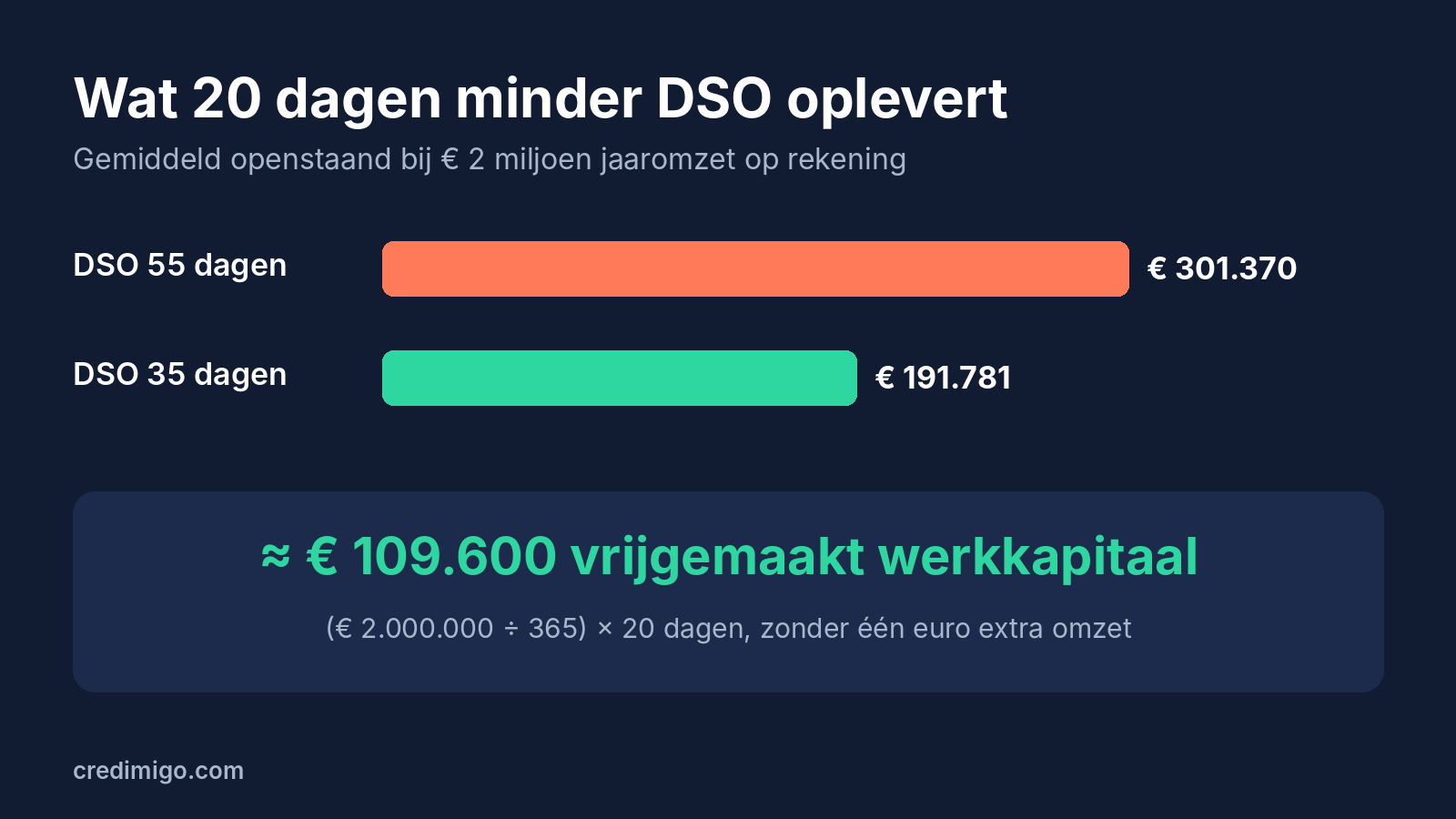
A business with €2 million annual credit sales and a DSO of 55 days has about €300,000 outstanding. Cutting DSO to 35 days frees roughly €109,600: (€2,000,000 ÷ 365) × 20. No loan, no interest, no extra customer needed.
Phase 1: before the invoice
- 1. Check new customers' creditworthiness – Chamber of Commerce data and payment history.
- 2. Agree clear, short payment terms. In the Netherlands B2B terms are max. 60 days, 30 days if nothing is agreed. State a concrete due date on the invoice.
- 3. Ask for a deposit (30–50%) on larger projects, or invoice per milestone.
- 4. Record the right contact, invoice address and PO number up front.
- 5. Use solid terms and conditions covering payment terms, interest and collection costs.
Phase 2: at the invoice
- 6. Invoice immediately after delivery – not at month-end.
- 7. Send an error-free invoice: amount, VAT, reference, address, due date.
- 8. Add a payment link or QR code (iDEAL, Wero, card or bank transfer).
- 9. Prepare for e-invoicing – the Netherlands plans mandatory domestic B2B e-invoicing from 1 July 2030.
- 10. Offer an early-payment discount selectively – it's an expensive form of financing.
Phase 3: after the invoice
- 11. Send a friendly reminder five days before the due date.
- 12. Use a fixed follow-up schedule: day 0, +3, +10, +17 and +31.
- 13. Call, don't just email – a short call reveals the real reason for delay.
- 14. Announce interest and collection costs. Dutch commercial statutory interest is 10.4% since 1 July 2026; B2B arrears entitle you to at least €40 plus scaled costs (max €6,775). Consumers first need a free 14-day letter.
- 15. Measure DSO weekly, per customer and sector, with an aging analysis (0–30, 31–60, 61–90, 90+ days).
Why manual accounts receivable doesn't scale
These 15 steps aren't hard – they just have to happen every day, for every invoice, without exception. Credimigo works as an AI team for your whole receivables process: invoicing, automatic reminders, AI calls, payment links and follow-up, in every language across Europe – while you keep the customer relationship.
Start today with three quick wins: invoice immediately, add a payment link and send a reminder before the due date. Last updated 13 October 2026; statutory interest is revised every six months.
Frequently asked questions
What is a good DSO?
Close to your own payment terms. With 30-day terms, 30–40 days is healthy; structurally 15+ days above your terms means room for improvement.
What is the difference between DSO and payment terms?
Payment terms are what you agree; DSO is what actually happens. The gap shows how effective your receivables management is.
How fast can I reduce my DSO?
Immediate invoicing, payment links and pre-due reminders often work within one 30–60 day invoice cycle; structural improvement usually within a quarter.
Can I charge statutory interest to business customers?
Yes. In the Netherlands commercial statutory interest applies from the day after the due date, even if not agreed separately.
What if a customer still doesn't pay?
Then a formal demand and possibly a collection process follow.
Bronnen
Analyseer je eerste factuur gratis
Upload een openstaande factuur en zie binnen een minuut je Recovery Score, de juiste taal voor je debiteur en een kant-en-klare laatste aanmaning.
Analyse an invoice free