
Published 2026-10-19 · 9 min
The best debt collection agency in the Netherlands (and Europe) in 2026: how to choose the right collection approach
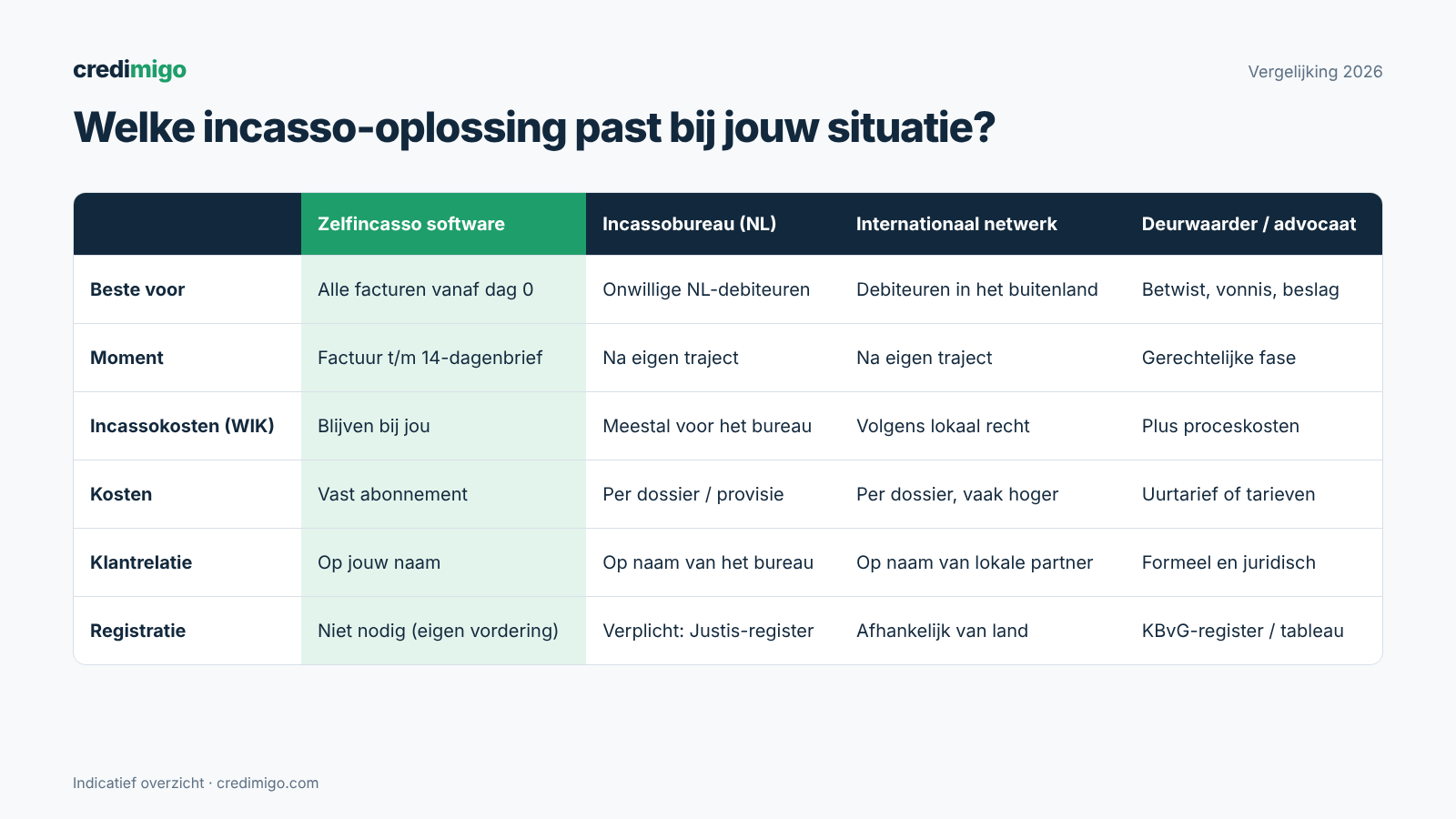
No debt collection agency is the best for everyone. The best collection approach depends on your situation. For most unpaid invoices, self-collection with accounts receivable software is the best and cheapest route, from invoice to the Dutch 14-day letter. If that fails, choose an agency registered with Justis, with transparent fees and a tone that protects the customer relationship. If your debtor is in another EU country, you need an agency with a local network or you can use the European Payment Order. For disputed claims, a judgment or seizure, go to a bailiff or lawyer.
Why "the best collection agency" doesn't exist
Search for "best debt collection agency in the Netherlands" and you mostly find lists written by agencies themselves. This guide shows how to decide what works best for you, which laws protect you and what to watch for across Europe.
An agency that excels at consumer collection is not automatically good at B2B. One that is strong in the Netherlands doesn't always have a reliable network in Germany or France. And an agency with a low commission can still be expensive if it keeps the collection costs.
The better question: which solution fits which invoice? Almost every late payment has one of four causes:
- Forgotten or lost: the invoice is with the wrong person.
- Temporary cash squeeze: the customer wants to pay but can't right now.
- Unwillingness: the customer only pays under pressure.
- Dispute: the customer contests the invoice or the work delivered.
Causes 1 and 2 are solved fastest with a good, timely reminder — no agency needed. An agency becomes relevant at cause 3, and at cause 4 usually a lawyer or the court.
The four collection options compared
| Self-collection software | Collection agency (NL) | International network | Bailiff / lawyer | |
|---|---|---|---|---|
| Best for | All invoices from day 0 | Unwilling Dutch debtors | Debtors abroad | Disputed claims, judgment, seizure |
| When | Invoice up to 14-day letter | After your own process | After your own process | Court phase |
| Collection costs (WIK) | Stay with you | Usually kept by the agency | Under local law | Plus legal costs |
| What you pay | Fixed subscription | Per file or commission | Per file, often higher | Hourly or fixed fees |
| Customer relationship | In your name | In the agency's name | In a local partner's name | Formal and legal |
| Registration | Not needed for own claims | Mandatory in the Justis register | Depends on the country | Bailiff register or bar |
1. Self-collection with accounts receivable software
With self-collection you collect your own invoices without an intermediary. Software automatically sends reminders, demand letters and the 14-day letter, calculates interest and collection costs, and lets your customer pay online. You remain the creditor and the money goes straight to you.
Collecting your own claims falls outside the registration requirement of the Dutch Debt Collection Services Quality Act (Wki), which applies to parties collecting on behalf of others or that have bought claims.
2. A Dutch collection agency
An agency takes over when your own reminders have not worked. It sends demand letters on your behalf, calls the debtor and agrees payment plans. It may not use enforcement measures such as seizure.
3. An international collection network
If you have customers in Belgium, Germany, France or another EU country, an agency usually works with local partners who know the language, local cost rules and court procedures. Always ask which partner does the work in which country and who remains responsible if things go wrong.
4. Bailiff or collection lawyer
If a debtor still doesn't pay, or disputes the claim, you need a judgment. A court bailiff can then seize assets. Bailiffs and lawyers don't need to register in the Wki register because they are already in the bailiff register or on the roll of the bar.
The key check in 2026: is the agency registered with Justis?
Since 1 October 2026 the Wki is fully in force. If a collection service provider is not registered, the debtor owes no collection costs and no accruing interest — only the original debt remains due. This also applies to a successor taking over a file from an unregistered agency.
Courts check it too: since 1 October 2026 a summons or petition claiming payment to a collection service provider must include, among other things, its name and registration number.
On 11 June 2026, 269 parties were listed in the register. The register is public: always check it yourself before handing over a file.
7 criteria for choosing the best collection agency
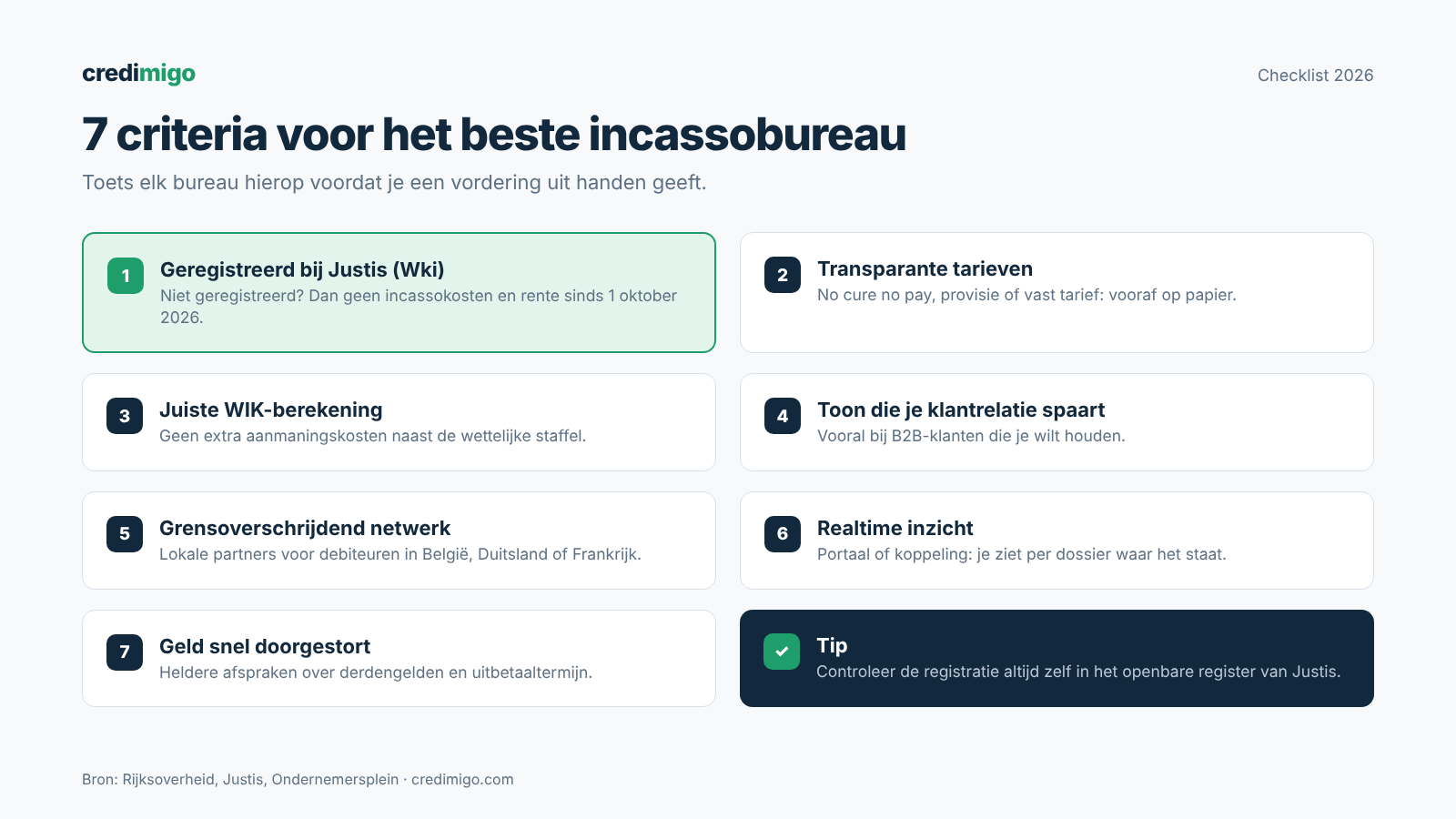
Use this checklist when comparing agencies:
- Registered with Justis. No registration, no collection costs or interest. Non-negotiable.
- Transparent fees. Know upfront whether it's no cure no pay, commission or a fixed fee per file.
- Correct WIK calculation. Costs per the statutory scale, with no separate reminder or admin fees.
- A tone that protects the relationship. Especially for B2B customers you want to keep. Ask for sample letters.
- A cross-border network. Important if you have customers abroad.
- Real-time insight. A portal or integration shows the status of each file.
- Fast payouts. Clear agreements on client funds and how quickly collected amounts reach you.
What may a Dutch agency charge in 2026?
Extrajudicial collection costs are set by law in the WIK scale:
| Part of the principal | Collection costs |
|---|---|
| First €2,500 | 15% |
| Next €2,500 | 10% |
| Next €5,000 | 5% |
| Next €190,000 | 1% |
| Above that | 0.5% |
Minimum €40, maximum €6,775. For consumers and sole traders these costs only apply after a valid 14-day letter. Statutory interest is 10.4% for commercial transactions since 1 July 2026 and 4% for consumers since 1 January 2026.
Mind the difference between what the debtor pays and what you receive. With no cure no pay the agency usually keeps the collection costs; with self-collection they stay with you. On a €2,000 invoice that easily makes €300 per file.
The best collection agency in Europe: how cross-border collection works
A "best collection agency in Europe" doesn't exist either. But there are EU rules that apply to every business, and two procedures you can use yourself.
The EU Late Payment Directive (2011/7/EU)
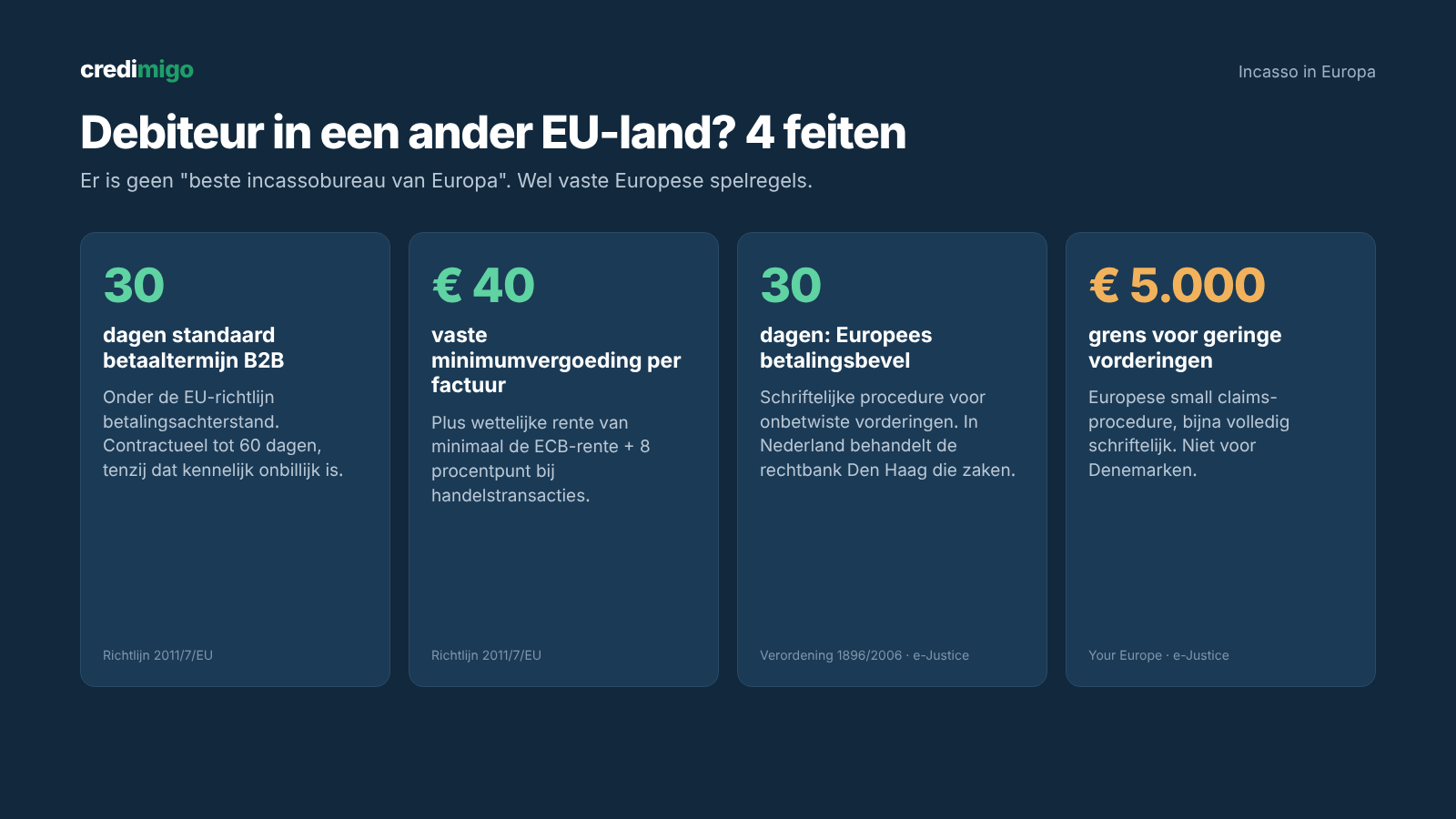
For business transactions in the EU the default payment term is 30 days. You may agree up to 60 days, unless that is grossly unfair to the creditor. If your customer pays late you are entitled to statutory interest of at least the ECB rate plus 8 percentage points and a fixed compensation of at least €40 per invoice.
Brussels proposed a regulation with a hard 30-day term, but it has stalled for a long time because several member states, including Germany and Austria, object. For now the existing directive remains the rule.
The European Payment Order and the Small Claims Procedure
For an undisputed cross-border claim you can apply for a European Payment Order. It is fully written, with standard forms. In the Netherlands the District Court of The Hague is the only competent court and normally issues the order within 30 days. If the debtor doesn't object, it becomes enforceable automatically.
For cross-border claims up to €5,000, excluding interest and costs, there is a simplified, almost entirely written European Small Claims Procedure. Neither procedure applies to Denmark.
With foreign customers too, start with a tight process of your own: a clear invoice in your customer's language, payment terms in line with the directive and timely reminders. Only then choose an agency with a proven network in the debtor's country, or use the European Payment Order yourself if the claim is undisputed.
What the best collection approach looks like
Combine the options instead of picking one:
- Day 0 to the 14-day letter: self-collection with software. Fast, cheap and in your name.
- After the 14-day letter: a Wki-registered agency for truly unwilling debtors.
- Foreign debtor: an agency with a local network or the European Payment Order.
- Disputed or no response: a lawyer or bailiff for a judgment and seizure.
That way you keep most invoices in your own hands and only pay for an agency when it's really needed.
How Credimigo helps
Credimigo is AI-driven accounts receivable software for self-collection — not a collection agency. Reminders, demand letters and 14-day letters go out automatically and on time, interest and collection costs are calculated under the statutory rules and your customer can pay online. You stay the creditor, payments go straight to you and you pay no commission on your own money.
This article is for information only and is not legal advice. Figures valid as of 19 October 2026.
Frequently asked questions
What is the best debt collection agency in the Netherlands?
No agency is best for everyone. The best one for you is registered with Justis, has transparent fees, charges collection costs per the WIK scale and fits your type of customers. For most invoices, self-collection with software is the best first step.
What is the best collection approach for businesses?
A combination: self-collection software from invoice to 14-day letter, a registered agency for unwilling debtors and a bailiff or lawyer for the court phase.
How do I check whether a collection agency is reliable?
Check the public Justis register of collection service providers. Since 1 October 2026 a debtor owes no collection costs or interest if the agency isn't registered.
What is the best debt collection agency in Europe?
There is no European agency that is best everywhere. Choose one with local partners in your debtor's country, or use the European Payment Order yourself for undisputed claims.
How do I collect an invoice from a customer in another EU country?
Start with your own reminders. If the claim is undisputed, apply for a European Payment Order — in the Netherlands at the District Court of The Hague. For claims up to €5,000 there is the European Small Claims Procedure.
Do I need to register to collect my own invoices?
No. Collecting your own claims falls outside the Wki registration requirement, which applies to parties collecting on behalf of others or that bought claims.
How much may a Dutch collection agency charge?
Per the WIK scale: 15% on the first €2,500, decreasing to 0.5%. Minimum €40, maximum €6,775. No separate reminder or admin fees on top.
What is the Dutch statutory interest rate in 2026?
10.4% for commercial transactions since 1 July 2026 and 4% for consumers since 1 January 2026.
Bronnen
- Rijksoverheid – No collection costs for unregistered providers (NL)
- Rijksoverheid – Collection costs (NL)
- Rijksoverheid – Statutory interest rates (NL)
- Justis – What is the Wki? (NL)
- Ondernemersplein – Collection agencies and bailiffs (NL)
- EUR-Lex – Directive 2011/7/EU on late payment
- European e-Justice – European Payment Order
- Your Europe – European Payment Order and small claims
Analyseer je eerste factuur gratis
Upload een openstaande factuur en zie binnen een minuut je Recovery Score, de juiste taal voor je debiteur en een kant-en-klare laatste aanmaning.
Analyse an invoice free