
Published 2026-09-29 · 9 min
What does a debt collection agency cost in the Netherlands in 2026? Fees, commissions and smarter alternatives
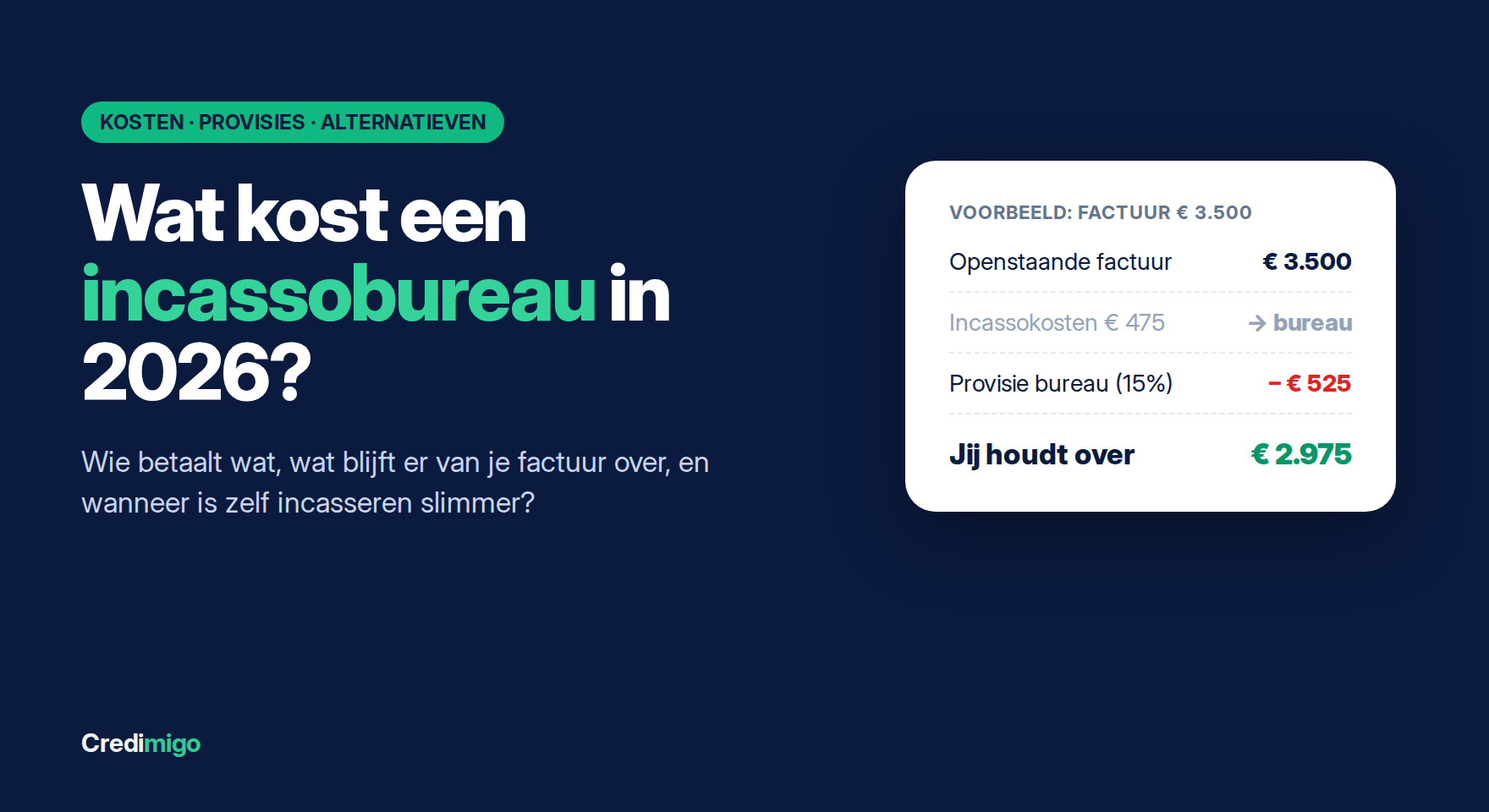
For Dutch debtors, a debt collection agency often costs you nothing as long as the debtor pays: the agency recovers the statutory collection costs from your customer — 15% of the first €2,500, minimum €40, maximum €6,775. But many agencies also charge a commission of 5% to 25% on the amount collected, start-up fees or a subscription, and the court phase is almost never no cure no pay. From 1 October 2026, if the agency is not listed in the Dutch Justis register, your customer owes no collection costs or accruing interest at all.
Who pays for a debt collection agency?
In principle the debtor pays. If a customer pays late, Dutch law lets you claim extrajudicial collection costs and statutory interest on top of the principal. Agencies usually keep those collection costs as their fee: you get the principal, the agency keeps the costs.
That sounds free, but watch three things:
- The collection costs are your right, not the agency's. You can claim them when you collect yourself.
- Extra costs are usually not recoverable — commission, file fees, start-up fees or subscriptions are paid by you as the client.
- If the debtor pays nothing or only part, your contract with the agency decides what you lose.
Statutory collection costs: the Dutch WIK scale in 2026
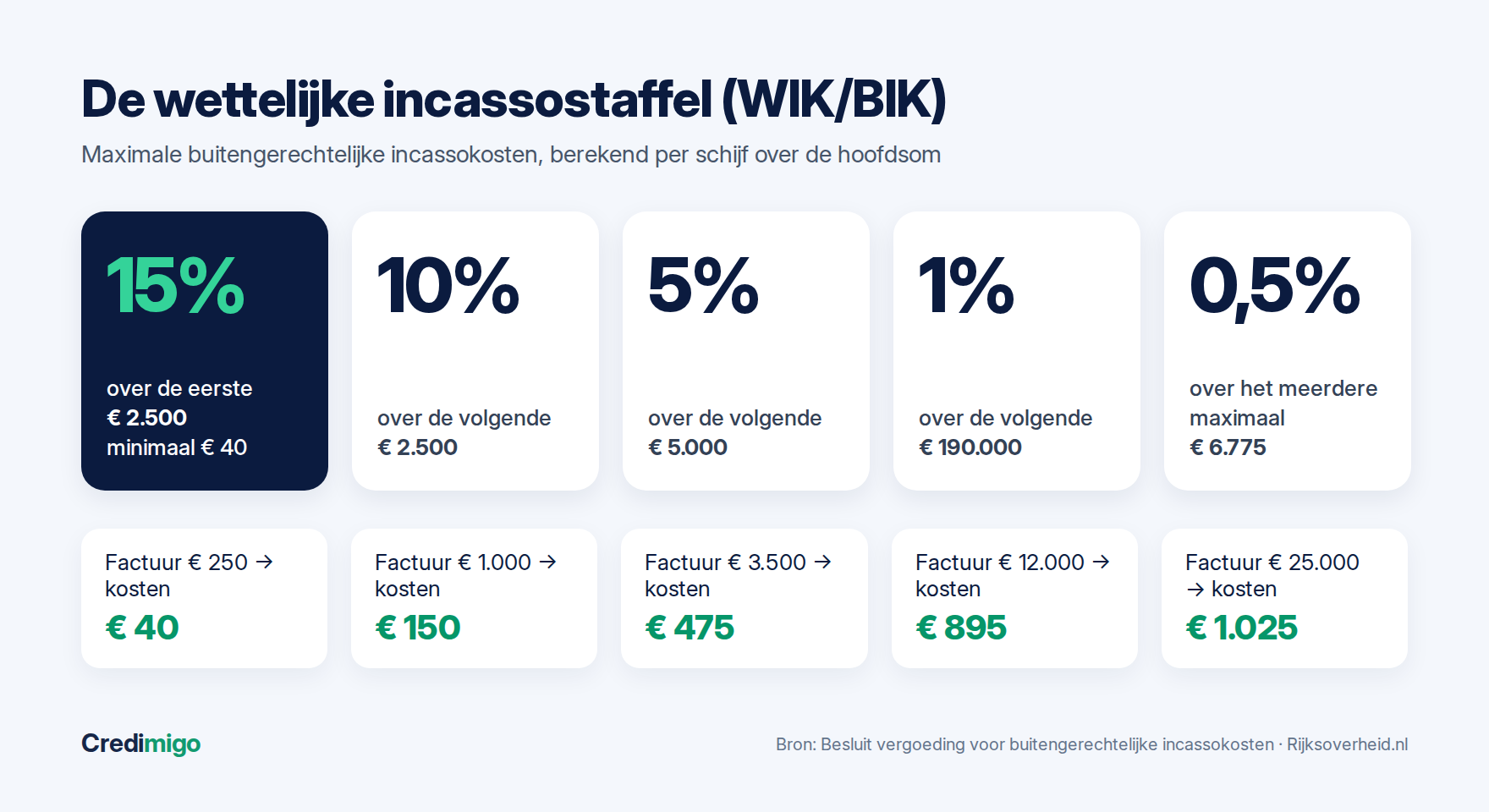
Maximum extrajudicial collection costs are fixed in the Dutch Decree on compensation for extrajudicial collection costs (BIK), calculated per bracket of the principal:
| Bracket of principal | Percentage |
|---|---|
| First €2,500 | 15% (minimum €40) |
| Next €2,500 | 10% |
| Next €5,000 | 5% |
| Next €190,000 | 1% |
| Above €200,000 | 0.5% (total maximum €6,775) |
Worked examples and common mistakes
Maximum collection costs by invoice amount:
- For consumers, costs may only be charged after a reminder with at least 14 days to pay — the '14-day letter' (WIK letter).
- For consumers, no extra reminder or administration fees may be added on top.
- VAT on collection costs is only allowed if you, the creditor, are not VAT-registered.
- For business customers the scale applies unless agreed otherwise; your terms may deviate if costs remain reasonable.
| Outstanding invoice | Maximum collection costs |
|---|---|
| €250 | €40 (minimum) |
| €1,000 | €150 |
| €3,500 | €475 |
| €12,000 | €895 |
| €25,000 | €1,025 |
You are also entitled to statutory interest: 10.4% for commercial transactions (B2B, since 1 July 2026) and 4% for consumers (since 1 January 2026). That interest belongs to you, not the agency.
The 4 pricing models of collection agencies
Agencies earn their money in different ways:
- No cure, no pay — you pay only on success. With partial payments or payment plans many agencies still charge 5–15% commission; disputed or foreign claims are often excluded.
- Commission — a percentage of the amount collected, roughly 10–25%, highest on small claims; around 15% is often quoted as average.
- Start-up or file fee — a fixed amount per file, often €15–€50, sometimes combined with commission.
- Subscription — a monthly fee for a set number of files or fully outsourced receivables management.
Then the court phase: summons, court fees and bailiff costs are almost always advanced by you, as no cure no pay rarely applies here. If the debtor cannot pay, that money is lost.
Example: what do you keep from a €3,500 invoice?
A business customer leaves €3,500 unpaid and pays in full after a reminder. Statutory collection costs are €475.
| Scenario | What happens to the €475? | What you receive |
|---|---|---|
| Agency, 15% commission | Goes to the agency | €2,975 |
| Agency, no cure no pay | Goes to the agency | €3,500 |
| Collecting yourself with software | Goes to you | €3,975 (minus subscription) |
Statutory interest excluded; it goes to the creditor in every scenario. The gap between worst and best case is €1,000 on a single invoice.
New from 1 October 2026: no registration, no collection costs
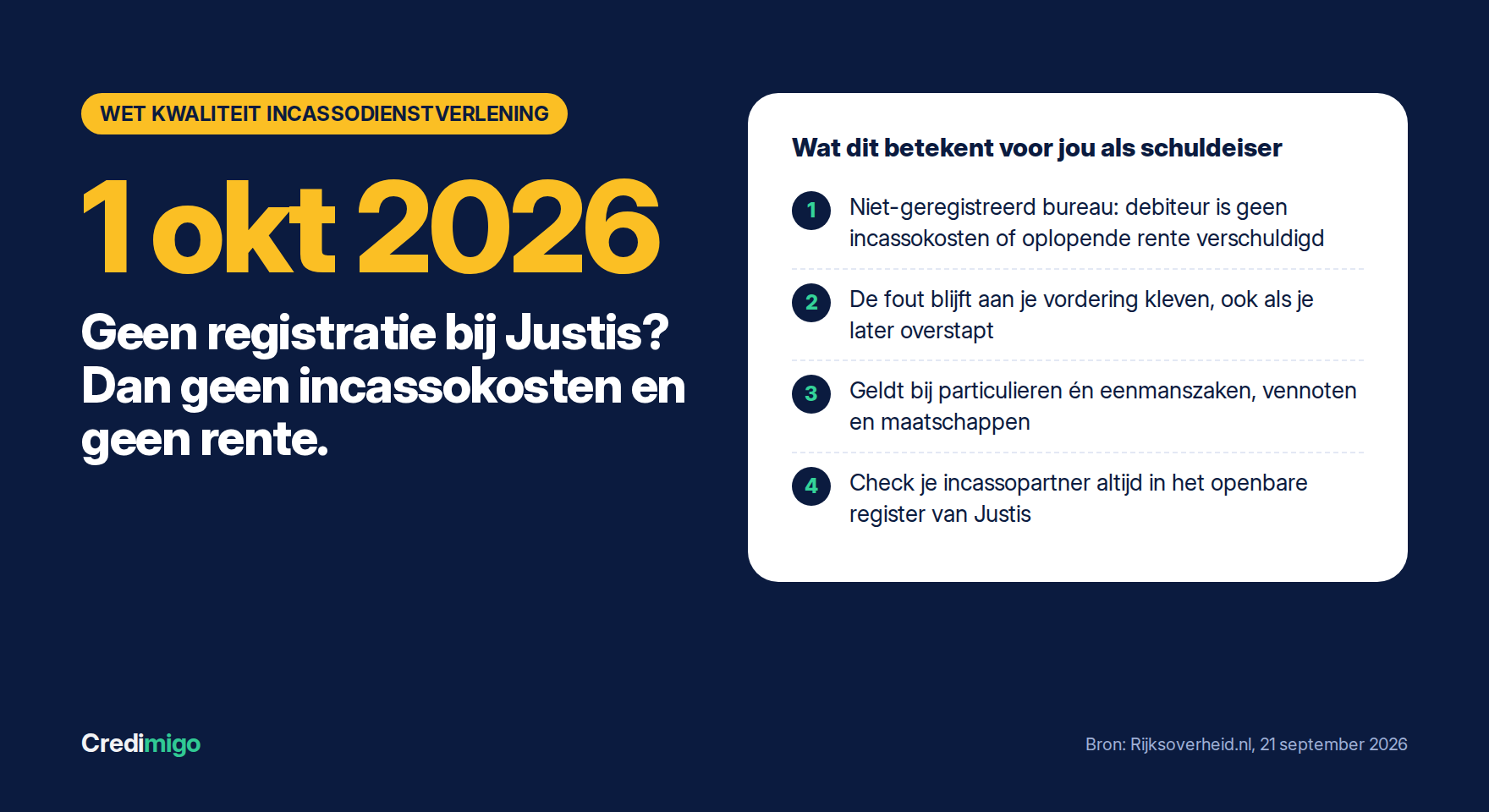
Since 1 April 2024 the Dutch Debt Collection Services Quality Act (Wki) requires collection agencies to register with Justis. From 1 October 2026 its most far-reaching article takes effect: a debtor owes no collection costs and no accruing interest if the agency is not registered. The original debt must still be paid (Rijksoverheid, 21 September 2026).
- Applies to consumers and to sole traders, partners and partnerships.
- A successor agency cannot charge those costs either — the error stays attached to your claim.
- Bailiffs and lawyers need not register; they are in their own professional registers.
Always check the public Justis register before handing over a file. Collecting your own claims — with your own software or in-house team — does not fall under the Wki registration duty. You remain the creditor and the collection costs remain yours.
Alternatives to a debt collection agency
From light to heavy:
- Better invoicing and follow-up — clear invoices with a payment link and timely reminders prevent most arrears.
- Collecting yourself — send a correct reminder or 14-day letter and claim the costs and interest yourself.
- Self-collection with receivables software — Credimigo automates reminders, calculates statutory costs and interest and lets customers pay online. You remain the creditor, with no commission on your own money.
- Registered agency or bailiff — for disputed, unresponsive or foreign cases, once your own process is exhausted.
This article is informational and not legal advice. Figures valid as of 29 September 2026.
Frequently asked questions
What does a debt collection agency cost on average?
With no cure no pay you often pay nothing if the debtor pays in full. With commission you pay roughly 10–25% of the amount collected, plus possible file fees of €15–€50.
How much collection costs may be charged in the Netherlands in 2026?
15% of the first €2,500, 10% of the next €2,500, 5% of the next €5,000, 1% of the next €190,000 and 0.5% above that. Minimum €40, maximum €6,775.
Can I charge collection costs without an agency?
Yes. They are the creditor's right. For consumers you must first send a 14-day letter.
Is no cure no pay really free?
Only if the debtor pays the full amount including costs. Partial payments often carry 5–15% commission, and the court phase is almost never covered.
What changes on 1 October 2026?
Debtors owe no collection costs or accruing interest if the agency used is not registered with Justis. The original debt remains due.
Does the Wki apply if I collect my own invoices?
No. Collecting your own claims, for example with your own receivables software, is not a collection service under the Wki.
Bronnen
Analyseer je eerste factuur gratis
Upload een openstaande factuur en zie binnen een minuut je Recovery Score, de juiste taal voor je debiteur en een kant-en-klare laatste aanmaning.
Analyse an invoice free