
Published 2026-10-06 · 6 min
Debt collection agency or accounts receivable software: what's the difference?
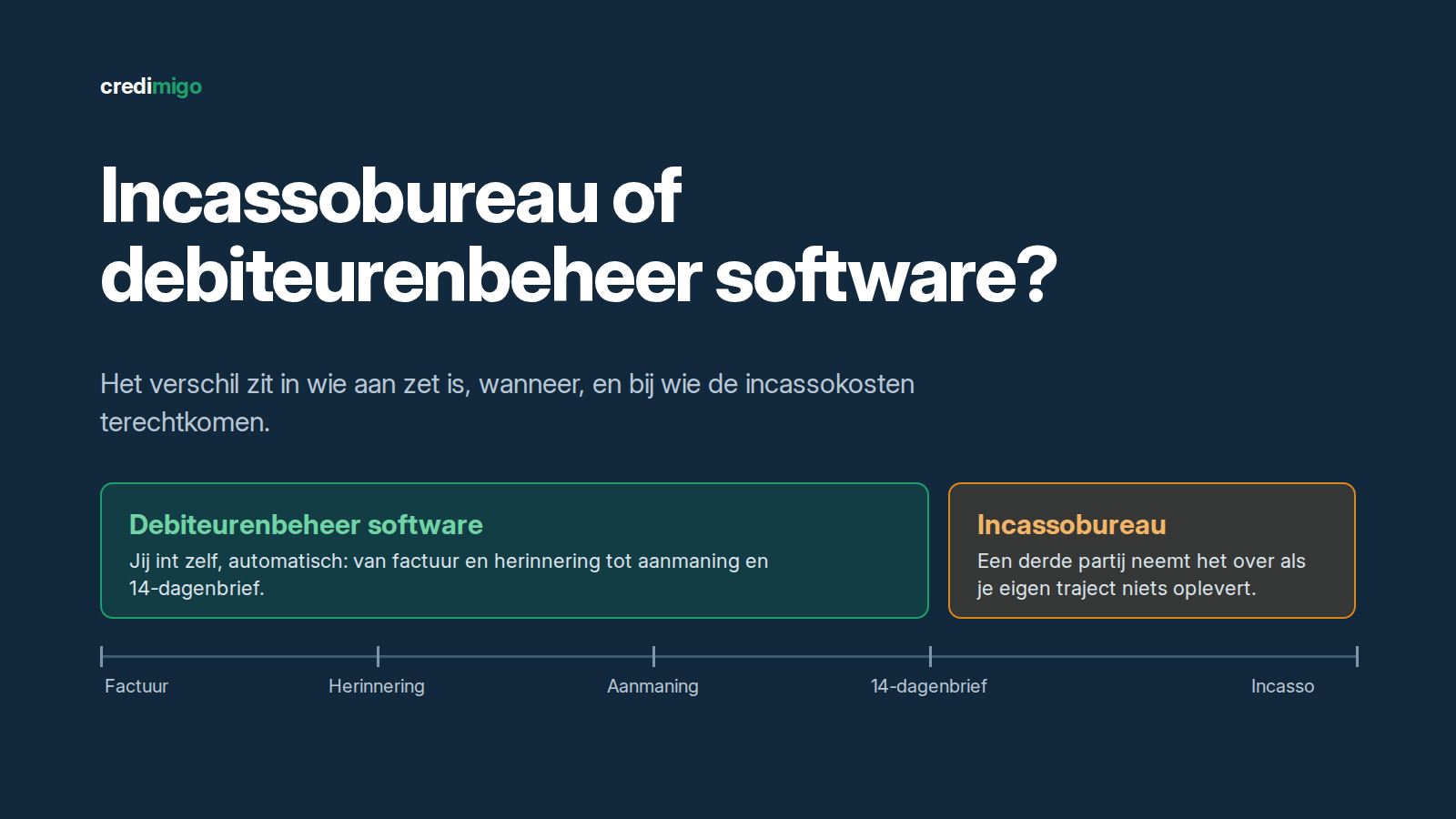
With accounts receivable software you collect your own invoices automatically – from invoice to reminder, demand letter and, for Dutch consumers, the 14-day letter. You stay in charge and the statutory collection costs stay with you. A collection agency is an outside party that takes over when your own process fails; on a no-cure-no-pay basis it usually keeps the collection costs. Software prevents and resolves early; an agency escalates. Most businesses need both, at different moments.
What is a collection agency?
An outside party that collects on your behalf, under its own name. It typically earns either the statutory collection costs (no cure, no pay) or a commission of often 10–25% of the amount collected. Since 1 October 2026, an agency collecting from Dutch individuals, sole traders or partners must be in the Justis register; otherwise the debtor owes no collection costs or interest.
What is accounts receivable software?
Software that automates follow-up of your open invoices in your own name: timely reminders and demand letters, a correct 14-day letter, interest and cost calculation where the law allows, a payment link and insight into who pays late. Collecting your own claims falls outside the Wki registration duty.
The difference at a glance
| AR software | Collection agency | |
|---|---|---|
| Who collects? | You, automated | An outside party for you |
| When? | From the invoice date | After reminder and demand |
| Customer contact | Your name, your tone | The agency's name |
| Collection costs | Stay with you | Usually kept by the agency |
| What you pay | Fixed, predictable software cost | Commission or costs per file |
| Wki registration | Not needed for own claims | Mandatory (Justis register) |
| Strong at | Prevention, early resolution | Escalation, unwilling debtors |
Difference 1: timing
Software starts the day you invoice; an agency arrives once there's a problem. Most late payments are forgetfulness or temporary cash gaps that one good reminder solves. Steps 1–4 of the collection ladder (invoice, reminder, demand, 14-day letter) you can do yourself; steps 5–6 (agency, court and bailiff) are for a registered agency, bailiff or lawyer.
Difference 2: who keeps the collection costs
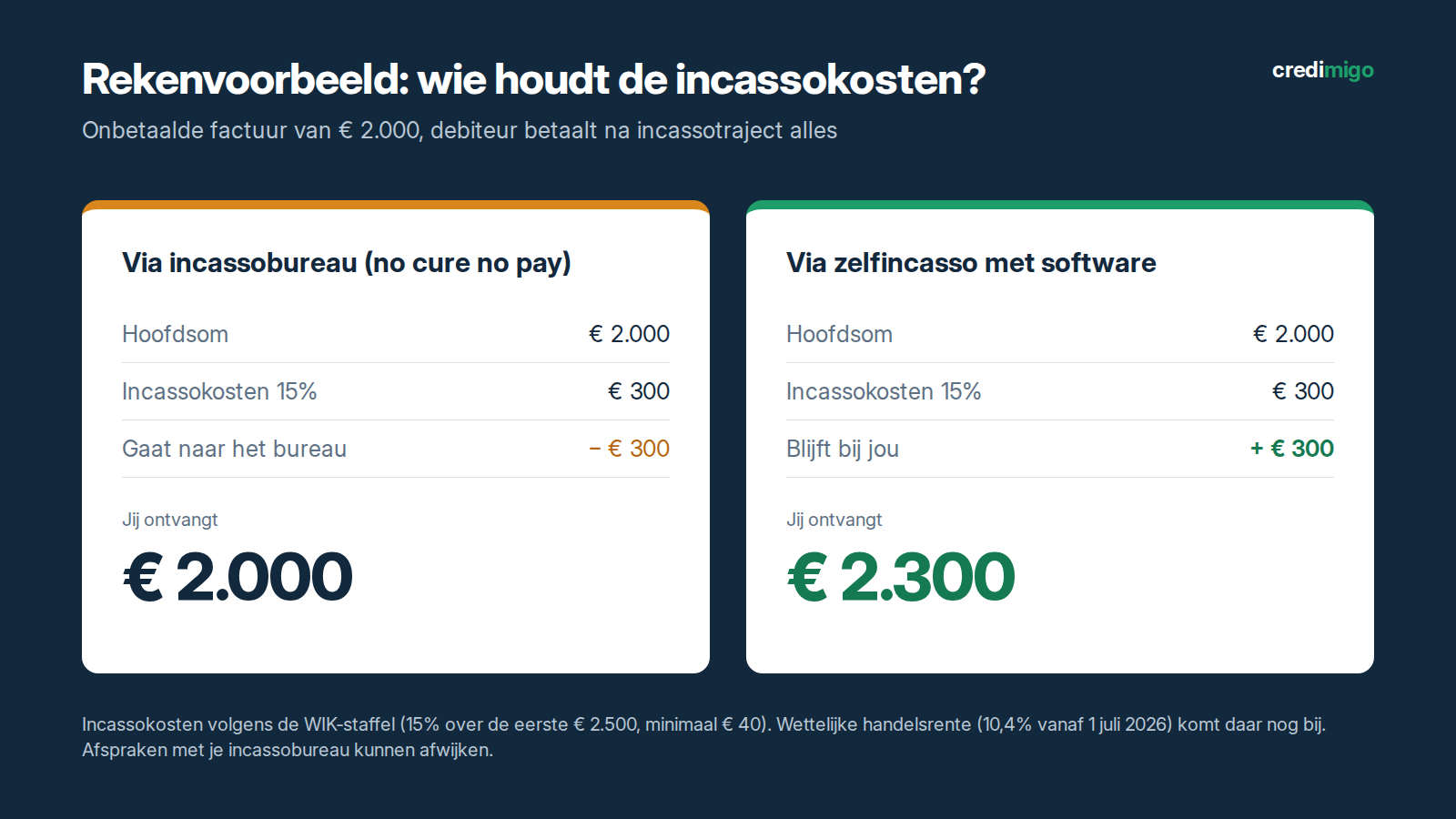
Dutch extrajudicial collection costs (WIK scale): 15% of the first €2,500 (min. €40), 10% of the next €2,500, 5% of the next €5,000, 1% of the next €190,000, 0.5% above (max. €6,775). Example: on a €2,000 invoice you receive €2,000 via a no-cure-no-pay agency, or €2,300 collecting yourself. Statutory interest: 10.4% commercial (since 1 July 2026), 4% consumer (since 1 January 2026). No separate reminder or admin fees may be added.
Differences 3 and 4: relationship and cost
An agency letter feels like escalation; with software the contact stays yours, in your tone and with your logo. Agencies cost per file; software has fixed, predictable costs and sends fewer files to an agency.
The smartest route: yourself first, then outsource
Use software for the early phase and a registered agency or bailiff only for files that truly stall. Credimigo is AI-driven AR software for self-collection, not a collection agency: you stay the creditor and payments go straight to you.
This article is for information only and is not legal advice. Figures valid as of 6 October 2026.
Frequently asked questions
What is the difference between a collection agency and AR software?
With software you collect your own invoices automatically from the invoice date, in your own name. An agency takes over after your own reminders have failed.
Is AR software an alternative to an agency?
For the early phase, yes. For disputed claims, foreign debtors or court proceedings you still need an agency, bailiff or lawyer.
Does AR software need Wki registration?
No – collecting your own claims falls outside the Wki registration duty.
What if my agency is not registered?
Since 1 October 2026 the debtor owes no collection costs or interest; the principal remains due.
Bronnen
Analyseer je eerste factuur gratis
Upload een openstaande factuur en zie binnen een minuut je Recovery Score, de juiste taal voor je debiteur en een kant-en-klare laatste aanmaning.
Analyse an invoice free