Published 2026-11-16 · 8 min
Email, SMS, WhatsApp or phone for unpaid invoices: what works best?
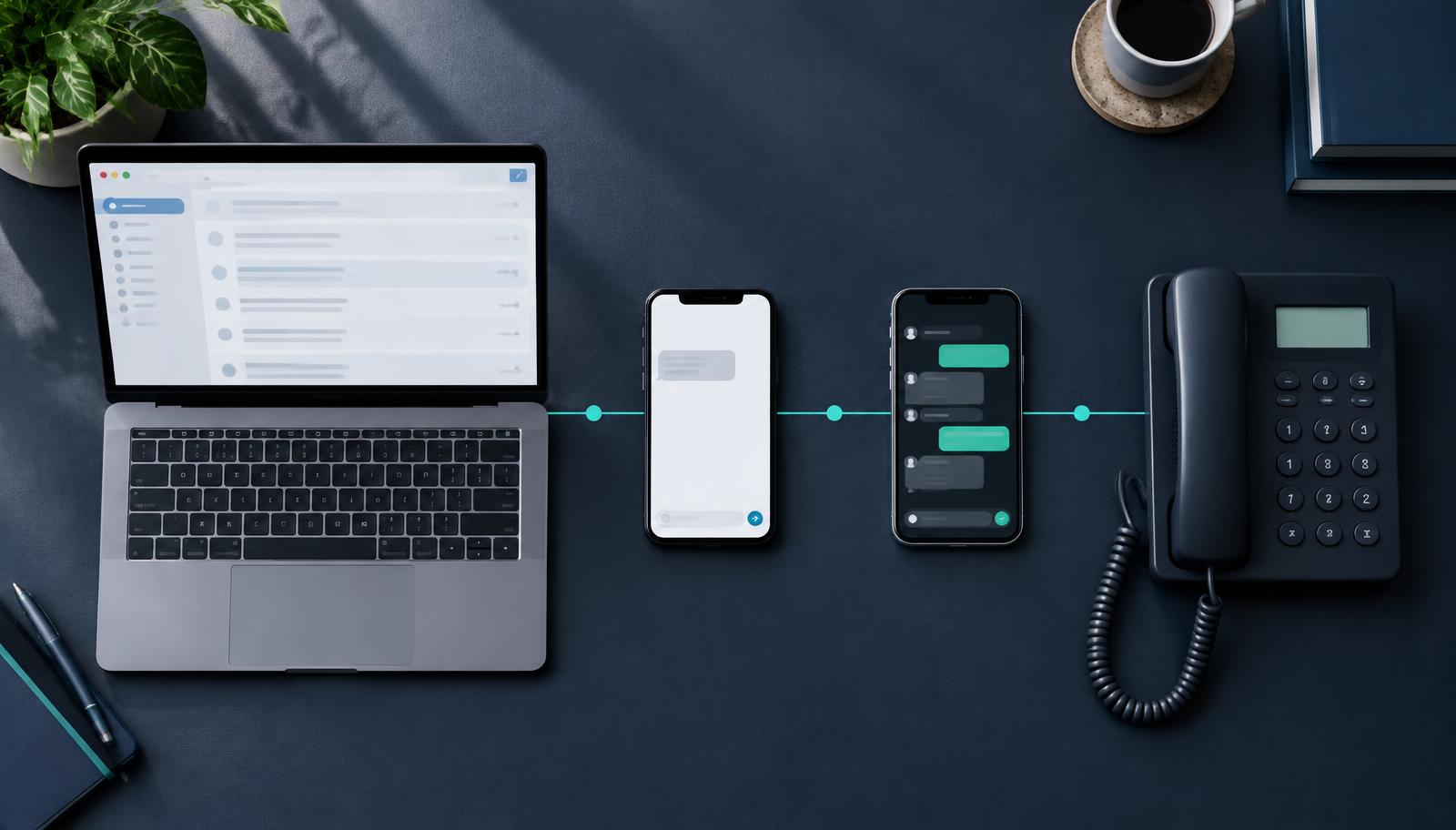
No single channel works best on its own; a combination works best. Email is the foundation because it provides a useful evidence trail and can be used for the Dutch 14-day letter (veertiendagenbrief). SMS and WhatsApp help ensure your reminder actually gets read. Use phone calls when a customer still has not responded after a few reminders. Businesses that use these channels in a fixed sequence at set intervals get paid faster and need to involve a collection agency less often.
The invoice is overdue, and there is still no response
Every business owner knows the situation: the invoice has been sent, the payment deadline has passed and there is still no response. Then comes the question: should I send another email, an SMS, a WhatsApp message, or pick up the phone? This article compares the four channels on what really matters: whether the message gets read, how quickly the customer pays, what it costs and how strong your legal position is.
The legal rules described in this article are Dutch law; if you have customers elsewhere, check the local rules.
Why your choice of channel matters so much
Many late payments are not deliberate. The invoice is in a spam folder, the right person is on holiday or the payment has simply been forgotten. A reminder that nobody reads achieves nothing. Your choice of channel therefore determines whether your customer sees the reminder at all, and how easily they can pay afterwards. If the situation does escalate, read Payment term expired: what you can do.
1. Email: the foundation of your receivables management
Strengths: evidence, scale, low cost and formal communication. Weaknesses: readership and response speed.
Email remains the standard channel for invoices and reminders. You can attach the invoice, include a payment link and maintain a clear trail for your records.
Important for businesses in the Netherlands: the Dutch 14-day letter (veertiendagenbrief), the final demand required before charging consumers extrajudicial collection costs, does not have to be sent by post. On 13 June 2014, the Dutch Supreme Court ruled (ECLI:NL:HR:2014:1405) that the legislature leaves creditors free to decide how to organise the collection process; in 2017, the Court of Appeal of ’s-Hertogenbosch inferred from this that the 14-day letter may also be sent by email. Take care with the deadline: the Supreme Court ruled that the fourteen days begin on the day after the demand is received (Supreme Court, 25 November 2016, ECLI:NL:HR:2016:2704). See also the Dutch judiciary's recommendation on the 14-day letter.
The downside: email is read much less often than messages on a phone. In NP Digital's analysis of 2,731 campaigns, email was opened in 23.8% of cases, compared with 51.2% for SMS (NP Digital, 2025).
When to use it: before the due date, on the due date and for the formal demand or 14-day letter.
2. SMS: short, direct and likely to be read
Strengths: likelihood of being read, speed and simplicity. Weaknesses: room for explanation and evidence in a dispute.
An SMS arrives directly, without a spam filter or a crowded inbox getting in the way. The figures reflect this. The often-quoted 98% open rate mainly comes from marketing sources (CM.com). More recent measurements put the figure at around 50%. Even then, an SMS is read twice as often as an email and generates well over twice the click-through rate: 18.9% versus 7.3% (NP Digital).
For payment reminders, that means one sentence, the invoice number, the amount and a payment link. That is all you need.
Example: “Hi James, invoice 2026-0412 for €1,250 is still outstanding. Pay in 1 click here: [payment link]. Already paid? Please ignore this message. – Oakfield Services”
When to use it: 1 to 7 days after the due date, if the email has not produced a result.
3. WhatsApp: personal and interactive
Strengths: likelihood of being read, a personal tone and two-way conversation. Weaknesses: consent requirements and suitability for formal communication.
For many people in the Netherlands, WhatsApp is their main communication channel. Messages are opened quickly, and replying feels easy: “Can I pay in two instalments?” This often makes WhatsApp the channel where a payment plan takes shape rather than a conflict.
Keep two things in mind:
- Consent and a business account. Use WhatsApp Business (API) and make sure the customer has agreed to receive messages through this channel, for example in your terms and conditions or when setting up the customer account; WhatsApp requires this opt-in under its policy. Under the GDPR, you must also have a lawful basis for using the phone number and inform your customer about that use (Autoriteit Persoonsgegevens, the Dutch Data Protection Authority).
- Tone. WhatsApp feels personal. A threatening tone lands harder here than in an email. Keep it friendly and focused on a solution.
When to use it: 3 to 14 days after the due date, as a second or third reminder. Find all the rules and sample messages in WhatsApp payment reminders: what's allowed and what works.
4. Phone calls: the human breakthrough
Strengths: identifying the cause, reaching agreements and preserving the relationship. Weaknesses: cost, time, scalability and evidence.
A phone call is the most expensive channel, but often the most effective when a customer is not responding. In one conversation, you can discover whether there is an underlying issue, such as an invoice error or an unhappy customer, or whether the customer is short of cash. That completely changes your next step.
Important tip: immediately record every agreement reached by phone in writing with a short confirmation email. A verbal promise is difficult to prove in later proceedings.
When to use it: after 2 to 3 written reminders have produced no result, or immediately for large amounts and important customers.
The four channels compared
| Criterion | SMS | Phone | ||
|---|---|---|---|---|
| Likelihood of being read or heard | Low to medium | High | Very high | High (if answered) |
| Response speed | Days | Hours | Minutes to hours | Immediate |
| Cost per contact | Very low | Low | Low | High |
| Legal evidence | Strong | Moderate | Moderate | Weak |
| Suitable for the Dutch 14-day letter | Yes | Limited | Limited | No |
| Best timing | Before and on the due date | Days 1–7 | Days 3–14 | After 2–3 reminders |
The best approach: a multichannel reminder flow
The question is not whether to use email, SMS, WhatsApp or phone calls, but when to use each one. Here is a flow that works well in practice:
| Timing | Channel | Action |
|---|---|---|
| Day −3 | A friendly advance reminder that the invoice is nearly due. | |
| Day 0 | A message that the invoice is due today, with a payment link. | |
| Day +3 | SMS | A short reminder with a payment link. |
| Day +7 | A personal message offering the opportunity to reply or request a payment plan. | |
| Day +14 | The formal demand or Dutch 14-day letter. | |
| Day +21 | Phone | Identify the cause and agree a concrete next step. |
| Day +30 | Next step | A payment plan, collection action or handover. |
Every step must stop automatically as soon as payment arrives. Few things are more frustrating for a customer than a reminder for an invoice they paid yesterday. To learn how to automate the entire journey from invoice to payment, read Accounts receivable automation in the Netherlands: the complete guide.
5 mistakes businesses make with payment reminders
- Using only one channel. Three consecutive unread emails are still unread.
- Starting too late. The longer an invoice remains outstanding, the less likely it is to be paid.
- Leaving out the payment link. Every extra step, such as typing an IBAN or finding a payment reference, costs you payments.
- Using the wrong tone. Start politely and become more formal in stages. Find sample wording in [Payment reminders and demand letters: examples](/en/blog/payment-reminder-and-demand-letter-example).
- Doing everything manually. Manual reminders take time, get missed during busy periods and are difficult to sustain.
How Credimigo automates this
Credimigo is AI-powered accounts receivable software that runs this entire flow for you while you remain the creditor. You set up once which channels you want to use on which days. Credimigo then sends reminders automatically by email, SMS and WhatsApp, including a payment link, and stops as soon as payment arrives. If a customer does not respond, you receive a notification that it is time to call, with all previous contact in one place.
This keeps receivables management in your hands, preserves good customer relationships and helps you get paid faster. Read also Automating the accounts receivable process: from invoice to payment.
Frequently asked questions
What is the best channel for reminding customers about an unpaid invoice?
A combination works best: email for formal communication and evidence, SMS and WhatsApp for a high likelihood of being read and prompt payment, and phone calls when the customer does not respond.
Can I send a Dutch 14-day letter by email?
Yes. The 14-day letter does not have to be sent by post; courts also accept email. The fourteen-day period begins on the day after receipt (Dutch Supreme Court, 25 November 2016).
Can I remind customers about an unpaid invoice through WhatsApp?
Yes, provided you use a WhatsApp business account and the customer has consented to communication through this channel. Keep the tone friendly and professional.
How often can I remind a customer about an unpaid invoice?
There is no statutory maximum. In practice, 3 to 5 contacts spread over approximately 30 days work well, with the tone becoming progressively more formal.
Is it still worth calling customers about overdue payments?
Absolutely. Calling is expensive, but it is often when you discover the real cause of a late payment and can reach an agreement. Always confirm agreements in writing.
How can I get invoices paid faster?
Start sending reminders before the due date, always include a payment link, use several channels and automate the process, for example with Credimigo.
Bronnen
- Hoge Raad 25 november 2016, ECLI:NL:HR:2016:2704 (aanvang veertiendagentermijn)
- Hoge Raad 13 juni 2014, ECLI:NL:HR:2014:1405 (veertiendagenbrief, vrije vorm van incassohandelingen)
- LAWFOX – De veertiendagenbrief kan ook per e-mail (Gerechtshof ’s-Hertogenbosch)
- Rechtspraak.nl – Aanbeveling over de 14-dagenbrief
- NP Digital (Neil Patel) – Email vs text message marketing performance
- CM.com – Achieve a 98% open rate with SMS
- WhatsApp Business Messaging Policy (opt-in)
- Autoriteit Persoonsgegevens – Stappenplan: mag ik als mkb’er persoonsgegevens verwerken?
Analyseer je eerste factuur gratis
Upload een openstaande factuur en zie binnen een minuut je Recovery Score, de juiste taal voor je debiteur en een kant-en-klare laatste aanmaning.
Analyse an invoice freeKeep reading
- AI voice agents for accounts receivable: how do they work?
- Credit management in the Netherlands: meaning, process and automation
- Accounts receivable automation in the Netherlands: the complete guide
- Automating the accounts receivable process: from invoice to payment
- WhatsApp payment reminders: what's allowed and what works
- Payment reminders and demand letters: examples
- Get invoices paid faster with a follow-up schedule
- Payment term expired: what you can do
- E-mail, sms, WhatsApp of bellen bij openstaande facturen (NL)